

[Mar 22, 2026] Free NSE 7 Network Security Architect NSE7_LED-7.0 Exam Question
NSE7_LED-7.0 dumps & NSE 7 Network Security Architect sure practice dumps
Fortinet is a renowned provider of network security solutions that ensure the safety of data, devices, and networks. The company offers a range of certifications and training programs to equip IT professionals with the necessary skills to manage and secure networks. One of the certifications offered by Fortinet is the Fortinet NSE 7 - LAN Edge 7.0 or NSE7_LED-7.0 exam.
NEW QUESTION # 22
Refer to the exhibit.
Examine the LDAP server configuration shown in the exhibit Note that the Username setting has been expanded to display Its full content On the Windows AD server 10.0.1.10, the administrator used dsquery. which returned the following output:
According to the output which FortiGate LDAP setting is configured incorrectly''
- A. Common Name Identifier
- B. Bind Type
- C. Username
- D. Distinguished Name
Answer: D
Explanation:
Explanation
According to the exhibits, the LDAP server configuration on FortiGate has the Distinguished Name set to
"dc=training,dc=lab". However, according to the output of the dsquery command on the Windows AD server, the Distinguished Name of the domain should be "dc=trainingAD,dc=training,dc=lab". Therefore, option C is true because the Distinguished Name on FortiGate is configured incorrectly and does not match the actual Distinguished Name of the domain. Option A is false because the Common Name Identifier on FortiGate is configured correctly as "cn". Option B is false because the Bind Type on FortiGate is configured correctly as
"Regular". Option D is false because the Username on FortiGate is configured correctly as
"cn=admin,cn=users,dc=trainingAD,dc=training,dc=lab".
NEW QUESTION # 23
Refer to the exhibit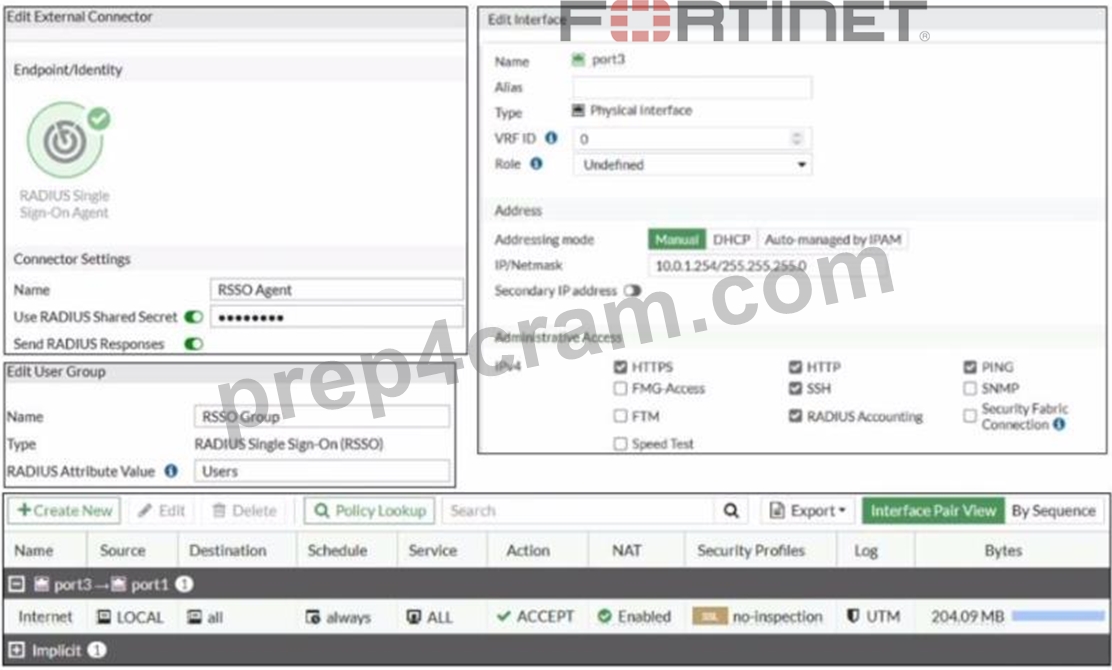
Examine the FortiGate RSSO configuration shown in the exhibit
FortiGate is configured to receive RADIUS accounting messages on port3 to authenticate RSSO users The users are located behind port3 and the internet link is connected to port1 FortiGate is processing incoming RADIUS accounting messages successfully and RSSO users are getting associated with the RSSO Group user group However all the users are able to access the internet, and the administrator wants to restrict internet access to RSSO users only Which configuration change should the administrator make to fix the problem?
- A. Change the RADIUS Attribute Value selling to match the name of the RADIUS attribute containing the group membership information of the RSSO users
- B. Enable Security Fabric Connection on port3
- C. Create a second firewall policy from port3 lo port1 and select the target destination subnets
- D. Add RSSO Group to the firewall policy
Answer: D
Explanation:
According to the exhibit, the firewall policy from port3 to port1 has no user group specified, which means that it allows all users to access the internet. Therefore, option B is true because adding RSSO Group to the firewall policy will restrict internet access to RSSO users only. Option A is false because changing the RADIUS Attribute Value setting will not affect the firewall policy, but rather the RSSO user group membership. Option C is false because enabling Security Fabric Connection on port3 will not affect the firewall policy, but rather the communication between FortiGate and other Security Fabric devices. Option D is false because creating a second firewall policy from port3 to port1 will not affect the existing firewall policy, but rather create a redundant or conflicting policy.
NEW QUESTION # 24
An administrator is deploying a new FortiGate device using zero-touch provisioning. Before deployment, the administrator added the FortiGate serial number on FortiManager and configured all the FortiGate settings FortiGate has a factory default configuration. However, when the administrator connects FortiGate to the network, FortiManager does not start the installation automatically. Which two scenarios are likely to cause this issue? (Choose two.)
- A. The DHCP server that serves FortiGate is not configured with options 240 and 241.
- B. The serial number added on FortiManager does not match the FortiGate serial number.
- C. Zero-touch provisioning is disabled on FortiManager.
- D. The pre-shared key set on FortiManager does not match the one set on FortiGate.
Answer: A,B
Explanation:
https://docs.fortinet.com/document/fortimanager/7.6.1/administration-guide/155479/zero-touch-and-low- touch-provisioning
NEW QUESTION # 25
Which two statements about MAC address quarantine by redirect mode are true? (Choose two)
- A. The device MAC address is added to the Quarantined Devices firewall address group
- B. The quarantined device is kept in the current VLAN
- C. It is the default mode for MAC address quarantine
- D. The quarantined device is moved to the quarantine VLAN
Answer: A,B
Explanation:
MAC address quarantine by redirect mode allows you to quarantine devices by adding their MAC addresses to a firewall address group called Quarantined Devices. The quarantined devices are kept in their current VLANs, but their traffic is redirected to a quarantine portal.
NEW QUESTION # 26
An administrator has configured an SSID in bridge mode for corporate employees. All APs are online and provisioned using default AP profiles. Employees are unable to locate the SSID to connect.
Which two configurations can the administrator verify? (Choose two.)
- A. Verify that the SSID to an AP group that should be broadcasting the SSID is applied
- B. Verify that the Block Intra-SSID Traffic (intra-vap-privacy) option in the SSID configuration is disabled
- C. Verify that the SSID is manually applied on AP profiles for both 2.4 GHz and 5 GHz radios
- D. Verify that the broadcast SSID option is enabled in the SSID configuration
Answer: C,D
Explanation:
https://community.fortinet.com/t5/FortiGate/Technical-Tip-How-to-enable-and-disable-broadcast- of-SSID/ta-p/191840
NEW QUESTION # 27
Refer to the exhibit.
Examine the RADIUS server configuration shown in the exhibit
An administrator has configured a RADIUS server on FortiGate that points to FortiAuthenticator FortiAuthenticator is acting as an authentication proxy and is configured to relay all authentication requests to a remote Windows AD server using LDAP While testing the configuration the administrator noticed that the diagnosetest authserver command worked with PAP, however authentication requests failed when using MSCHAP2 Which two solutions can the administrator implement to get MSCHAP2 authentication to work'' (Choose two.)
- A. On FortiAuthenticator change the back-end authentication server from LDAP to RADIUS
- B. On FortiGate update the Secret setting on the RADIUS server
- C. On FortiGate configure the NAS IP setting on the RADIUS
server - D. On FortiAuthenticator enable Windows Active Directory Domain Authentication to add FortiAuthenticator to the Windows domain
Answer: A,D
Explanation:
Explanation
According to the exhibit, the RADIUS server configuration on FortiGate points to FortiAuthenticator, which is acting as an authentication proxy and is configured to relay all authentication requests to a remote Windows AD server using LDAP. However, LDAP does not support MSCHAP2 authentication, which is required for RADIUS. Therefore, option A is true because on FortiAuthenticator, enabling Windows Active Directory Domain Authentication will add FortiAuthenticator to the Windows domain and allow it to use MSCHAP2 authentication with the AD server. Option C is also true because on FortiAuthenticator, changing the back-end authentication server from LDAP to RADIUS will allow it to use MSCHAP2 authentication with the AD server. Option B is false because on FortiGate, configuring the NAS IP setting on the RADIUS server will not affect the MSCHAP2 authentication, but rather the source IP address of the RADIUS packets. Option D is false because on FortiGate, updating the Secret setting on the RADIUS server will not affect the MSCHAP2 authentication, but rather the shared secret between FortiGate and FortiAuthenticator.
NEW QUESTION # 28
Refer to the exhibits.
Exhibit.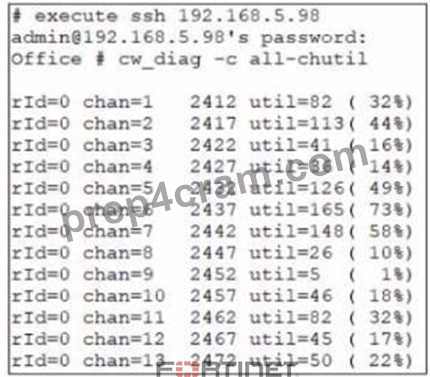
Examine the troubleshooting outputs shown in the exhibits
Users have been reporting issues with the speed of their wireless connection in a particular part of the wireless network The interface that is having issues is the 2 4 GHz interface that is currently configured on channel 6 The administrator of the wireless network has investigated and surveyed the local RF environment using the tools available at the AP and FortiGate Which configuration would improve the wireless connection?
- A. Change the AP 2.4 GHz channel to 1.
- B. Change the AP 2.4 GHz channel to 13.
- C. Change the AP 2.4 GHz channel to 11
- D. Change the AP 2.4 GHz channel to 9.
Answer: A
Explanation:
According to the exhibits, the AP 2.4 GHz interface is currently configured on channel 6, which is overlapping with other nearby APs on channels 4 and 8. This can cause interference and reduce the wireless performance. Therefore, changing the AP 2.4 GHz channel to 1 would improve the wireless connection, as it would avoid the overlapping channels and use a non-overlapping channel instead. Option A is false because changing the AP 2.4 GHz channel to 11 would still overlap with other nearby APs on channels 9 and 13.
Option C is false because changing the AP 2.4 GHz channel to 9 would still overlap with other nearby APs on channels 6, 8, and 11. Option D is false because changing the AP 2.4 GHz channel to 13 would still overlap with other nearby APs on channels 9 and 11.
NEW QUESTION # 29
Refer to the exhibit. Examine the network diagram and packet capture shown in the exhibit.
The packet capture was taken between FortiGate and FortiAuthenticator, and shows a RADIUS Access-Request packet sent by FortiSwitch to FortiAuthenticator through FortiGate.
Why does the User-Name attribute in the RADIUS Access-Request packet contain the client MAC address?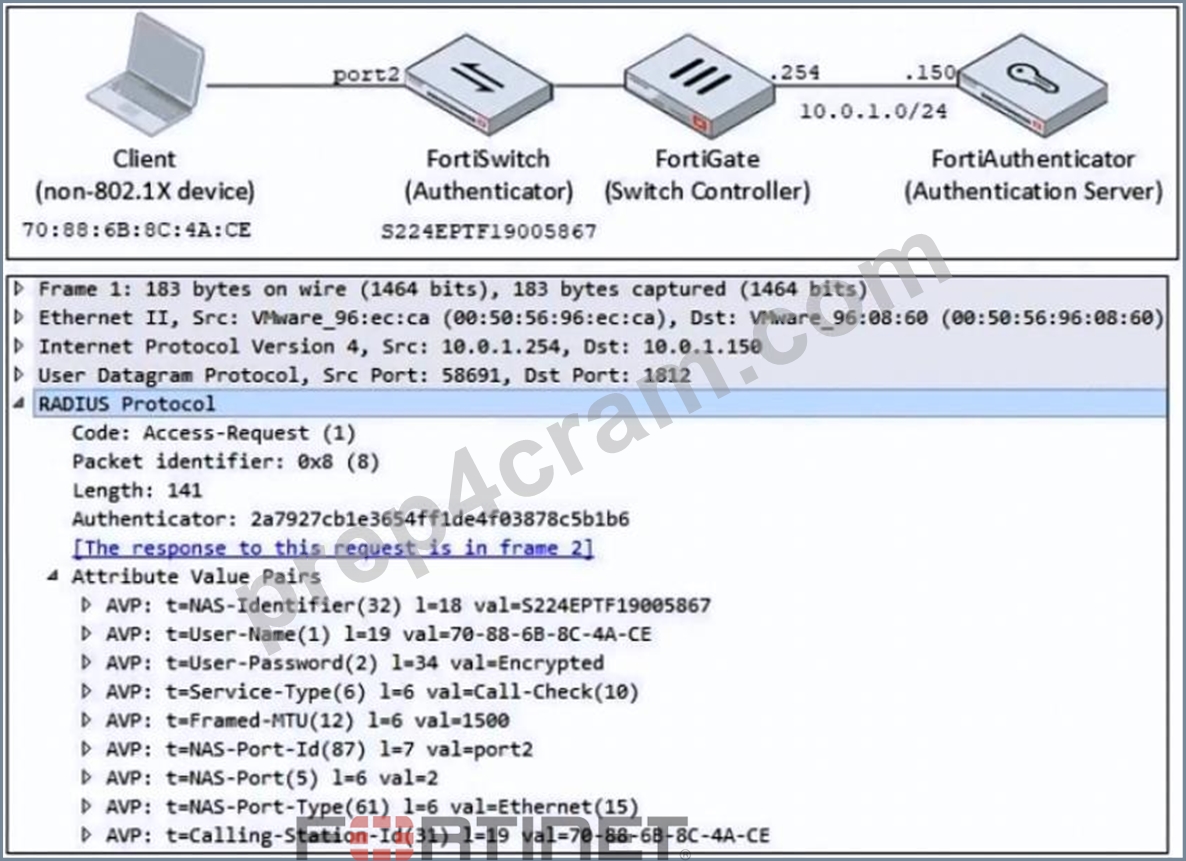
- A. FortiSwitch is authenticating the client using MAC authentication bypass
- B. The client is performing user authentication
- C. FortiSwitch is sending a RADIUS accounting message to FortiAuthenticator
- D. The client is performing AD machine authentication
Answer: A
Explanation:
According to the exhibit, the User-Name attribute in the RADIUS Access-Request packet contains the client MAC address of 00:0c:29:6a:2b:3d. This indicates that FortiSwitch is authenticating the client using MAC authentication bypass (MAB), which is a method of authenticating devices that do not support 802.1X by using their MAC address as the username and password.
NEW QUESTION # 30
Which two statements about FortiSwitch trunks are true? (Choose two.)
- A. A trunk is a link aggregation group interface.
- B. LACP is not supported.
- C. Trunks do not support tagged Ethernet frames.
- D. By default, when connecting two FortiSwitch devices to each other, a trunk is automatically created between the switches.
Answer: A,D
NEW QUESTION # 31
Refer to the exhibit.
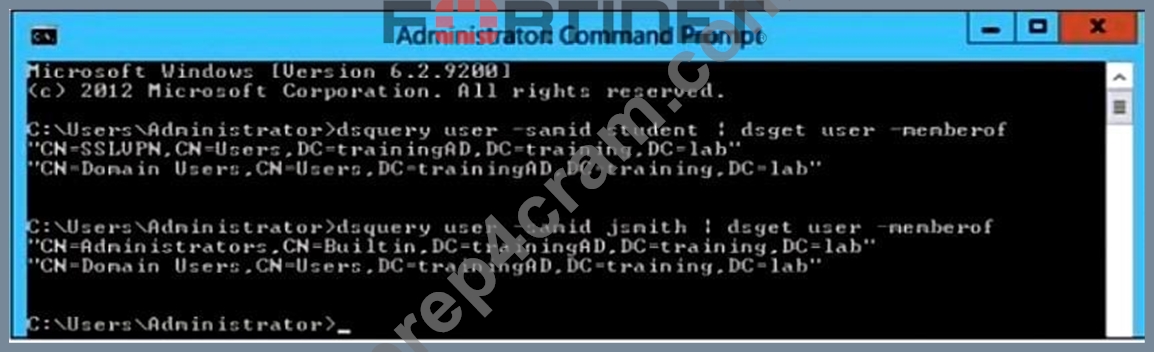
Examine the FortiGate user group configuration and the Windows AD LDAP group membership information shown in the exhibit FortiGate is configured to authenticate SSL VPN users against Windows AD using LDAP The administrator configured the SSL VPN user group for SSL VPN users However the administrator noticed that both the student and j smith users can connect to SSL VPN Which change can the administrator make on FortiGate to restrict the SSL VPN service to the student user only?
- A. In the SSL VPN user group configuration set Group Name to ::;=Domain users.CN-Users/DC=trainingAD, DC-training, DC=lab.
- B. In the SSL VPN user group configuration, change Name to cn=sslvpn, CN=users, DC=trainingAD, Detraining, DC-lab.
- C. In the SSL VPN user group configuration set Group Nam to CN-SSLVPN, CN="users, DC-trainingAD, DC-training, DC-lab
- D. In the SSL VPN user group configuration change Type to Fortinet Single Sign-On (FSSO)
Answer: C
Explanation:
Explanation
According to the FortiGate Administration Guide, "The Group Name is the name of the LDAP group that you want to use for authentication. The name must match exactly the name of the LDAP group on the LDAP server." Therefore, option A is true because it will set the Group Name to match the LDAP group that contains only the student user. Option B is false because changing the Name will not affect the authentication process, as it is only a local identifier for the user group on FortiGate. Option C is false because setting the Group Name to Domain Users will include all users in the domain, not just the student user. Option D is false because changing the Type to FSSO will require a different configuration method and will not solve the problem.
NEW QUESTION # 32
Which two statements about the use of digital certificates are true? (Choose two.)
- A. An intermediate CA can sign other certificates.
- B. To validate the signature on a certificate, an endpoint does not need to know the CA of that certificate.
- C. In a chain of trust, the root CA is signed by another certificate.
- D. A chain of trust may include one or more intermediate CAs.
Answer: A,D
NEW QUESTION # 33
You are configuring a FortiGate wireless network to support automated wireless client quarantine using IOC. Which two configurations must you put in place for a wireless client to be quarantined successfully? (Choose two)
- A. Configure the wireless network to be in tunnel mode
- B. Configure a firewall policy to allow communication
- C. Configure the wireless network to be in bridge mode
- D. Configure the FortiGate device in the Security Fabric with a FortiAnalyzer device
Answer: A,D
NEW QUESTION # 34
Refer to the exhibit.
An administrator wants to telnet into the S224EPTF19005867 switch over the FortiGate FortiLink interface.
Which configuration change should the administrator make?
- A. Enable telnet access on the FortiLink interface.
- B. On the default local-access profile, add telnet to the list of allowed protocols for mgmt-allowaccess.
- C. On the default local-access profile, add telnet to the list of allowed protocols for internal-allowaccess.
- D. Factory reset the switch to enable telnet access.
Answer: C
NEW QUESTION # 35
Refer to the exhibit.
Examine the debug output shown in the exhibit
Which two statements about the RADIUS debug output are true'' (Choose two)
- A. User authentication succeeded using MSCHAP
- B. The user student belongs to the SSLVPN group
- C. User authentication failed
- D. The RADIUS server sent a vendor-specific attribute in the RADIUS response
Answer: A,B
Explanation:
Explanation
According to the exhibit, the debug output shows a RADIUS debug output from FortiGate. The output shows that FortiGate sent a RADIUS Access-Request packet to FortiAuthenticator with the username student and received a RADIUS Access-Accept packet from FortiAuthenticator with a Class attribute containing SSLVPN.
Therefore, option A is true because it indicates that the user student belongs to the SSLVPN group on FortiAuthenticator. The output also shows that FortiGate used MSCHAP as the authentication method and received a MS-MPPE-Send-Key and a MS-MPPE-Recv-Key from FortiAuthenticator. Therefore, option D is true because it indicates that user authentication succeeded using MSCHAP. Option B is false because user authentication did not fail, but rather succeeded. Option C is false because FortiAuthenticator did not send a vendor-specific attribute in the RADIUS response, but rather standard attributes defined by RFCs.
NEW QUESTION # 36
Which two statements about the guest portal on FortiAuthenticator are true? (Choose two.)
- A. Administrators must approve all guest accounts before they can be used
- B. Each remote user on FortiAuthenticator can sponsor up to 10 guest accounts
- C. Administrators can use one or more incoming parameters to configure a mapping rule for the guest portal
- D. The guest portal provides pre and post-log in services
Answer: C,D
Explanation:
According to the FortiAuthenticator Administration Guide2, "The guest portal provides pre and post-log in services for users (such as password reset and token registration abilities), and rules and replacement messages can be configured." Therefore, option C is true. The same guide also states that "Administrators can use one or more incoming parameters to configure a mapping rule for the guest portal." Therefore, option D is true. Option A is false because remote users can sponsor any number of guest accounts, as long as they do not exceed the maximum number of guest accounts allowed by the license. Option B is false because administrators can choose to approve or reject guest accounts, or enable auto-approval.
NEW QUESTION # 37
Refer to the exhibits
The exhibits show the wireless network (VAP) SSID profiles defined on FortiManager and an AP profile assigned to a group of APs that are supported by FortiGate None of the APs are broadcasting the SSlDs defined by the AP profile Which changes do you need to make to enable the SSIDs to broadcast?
- A. In the SSIDs section enable Tunnel
- B. Enable multiple channels in the Channels section and enable Radio Resource Provision
- C. In the SSIDs section enable Manual and assign the networks manually
- D. Enable one channel in the Channels section
Answer: C
NEW QUESTION # 38
Refer to the exhibit. Examine the FortiSwitch security policy shown in the exhibit. If the security profile shown in the exhibit is assigned to all ports on a FortiSwitch device for 802.1X authentication, which statement about the switch is correct?
- A. All EAP messages will be terminated on FortiSwitch
- B. FortiSwitch cannot authenticate multiple devices connected to the same port
- C. FortiSwitch will try to authenticate non-802.1X devices using the device MAC address as the username and password
- D. FortiSwitch will assign non-802.1X devices to the onboarding VLAN
Answer: D
Explanation:
In cases where y device does not support 802.1x you can configure the security profile to place that device in the VLAN selected as GuestVLAN.
NEW QUESTION # 39
Refer to the exhibit. In the wireless configuration shown in the exhibits, an AP is deployed in a remote site and has a wireless network (VAP) called Corporate deployed to it. The network is a tunneled network however clients connecting to a wireless network require access to a local printer. Clients are trying to print to a printer on the remote site but are unable to do so.
Which configuration change is required to allow clients connected to the Corporate SSID to print locally?

- A. Configure the printer as a wireless client on the Corporate wireless network
- B. Configure split-tunneling in the vap configuration
- C. Configure split-tunneling in the wtp-profile configuration
- D. Disable the Block Intra-SSID Traffic (intra-vap-privacy) setting on the SSID (VAP) profile
Answer: B
Explanation:
Split tunneling allows you to specify which traffic is tunneled to the FortiGate and which traffic is sent directly to the Internet. This can improve performance and reduce bandwidth usage.
Therefore, by configuring split-tunneling in the vap configuration, you can allow the clients connected to the Corporate SSID to access both the corporate network and the local printer.
NEW QUESTION # 40
Refer to the exhibit. Examine the FortiGate user group configuration and the Windows AD LDAP group membership information shown in the exhibit.
FortiGate is configured to authenticate SSL VPN users against Windows AD using LDAP. The administrator configured the SSL VPN user group for SSL VPN users. However the administrator noticed that both the student and j.smith users can connect to SSL VPN.
Which change can the administrator make on FortiGate to restrict the SSL VPN service to the student user only?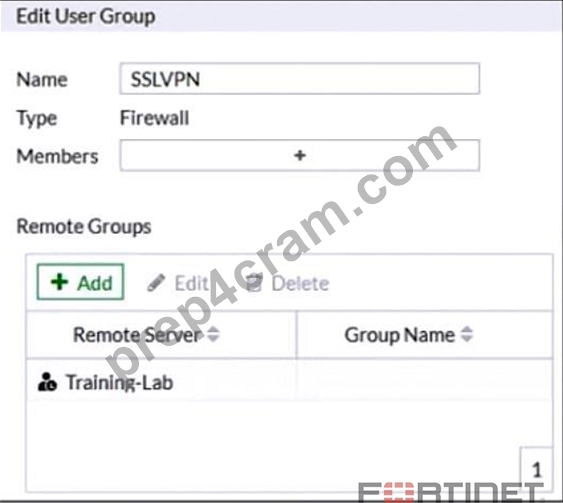
- A. In the SSL VPN user group configuration, change Name to
CN=SSLVPN,CN=Users,DC=trainingAD,DC=training,DC=lab. - B. In the SSL VPN user group configuration, set Group Name to CN=Domain Users,CN=Users,DC=trainingAD,DC=training,DC=lab.
- C. In the SSL VPN user group configuration, change Type to Fortinet Single Sign-On (FSSO).
- D. In the SSL VPN user group configuration, set Group Name to
CN=SSLVPN,CN=Users,DC=trainingAD,DC=training,DC=lab.
Answer: D
Explanation:
The Group Name is the name of the LDAP group that you want to use for authentication. The name must match exactly the name of the LDAP group on the LDAP server.
NEW QUESTION # 41
Which CLI command should an administrator use to view the certificate verification process in real time?
- A. diagnose debug application authd -1
- B. diagnose debug application radiusd -1
- C. diagnose debug application fnbamd -1
- D. diagnose debug application foauthd -1
Answer: C
Explanation:
NEW QUESTION # 42
You are configuring a FortiGate wireless network to support automated wireless client quarantine using IOC Which two configurations must you put in place for a wireless client to be quarantined successfully? (Choose two)
- A. Configure the wireless network to be in tunnel mode
- B. Configure a firewall policy to allow communication
- C. Configure the wireless network to be in bridge mode
- D. Configure the FortiGate device in the Security Fabric with a FortiAnalyzer device
Answer: A,D
Explanation:
Explanation
According to the FortiGate Administration Guide, "To enable automated wireless client quarantine using IOC, you must configure the following settings: Configure your wireless network to be in tunnel mode. This allows FortiGate to inspect all wireless traffic and applysecurity policies. Configure your FortiGate device in the Security Fabric with a FortiAnalyzer device. This allows FortiAnalyzer to detect indicators of compromise (IOC) from wireless traffic and send quarantine commands to FortiGate." Therefore, options A and B are true because they describe the configurations that must be put in place for a wireless client to be quarantined successfully using IOC. Option C is false because configuring a firewall policy to allow communication is not required, as the default firewall policy for tunnel mode wireless networks is to allow all traffic. Option D is false because configuring the wireless network to be in bridge mode is not supported, as FortiGate cannot inspect or quarantine wireless traffic in bridge mode.
NEW QUESTION # 43
Which three protocols are used for controlling FortiSwitch devices on FortiGate? (Choose three.)
- A. FTP
- B. FortiLink
- C. CAPWAP
- D. HTTPS
- E. IGMP
Answer: A,C,E
NEW QUESTION # 44
Refer to the exhibits.
Firewall Policy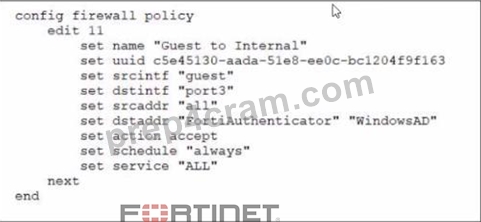
Examine the firewall policy configuration and SSID settings
An administrator has configured a guest wireless network on FortiGate using the external captive portal The administrator has verified that the external captive portal URL is correct However wireless users are not able to see the captive portal login page Given the configuration shown in the exhibit and the SSID settings which configuration change should the administrator make to fix the problem?
- A. Disable the user group from the SSID configuration
- B. Enable the captivs-portal-exempt option in the firewall policy with the ID 11.
- C. Apply a guest.portal user group in the firewall policy with the ID 11.
- D. Include the wireless client subnet range in the Exempt Source section
Answer: C
Explanation:
According to the FortiGate Administration Guide, "To use an external captive portal, you must configure a user group that uses the external captive portal as the authentication method and apply it to a firewall policy." Therefore, option C is true because it will allow the wireless users to be redirected to the external captive portal URL when they try to access the Internet. Option A is false because disabling the user group from the SSID configuration will prevent the wireless users from being authenticated by the FortiGate device. Option B is false because enabling the captive-portal-exempt option in the firewall policy will bypass the captive portal authentication for the wireless users, which is not the desired outcome. Option D is false because including the wireless client subnet range in the Exempt Source section will also bypass the captive portal authentication for the wireless users, which is not the desired outcome.
NEW QUESTION # 45
......
Fortinet NSE7_LED-7.0 (Fortinet NSE 7 - LAN Edge 7.0) Certification Exam is a globally recognized certification program that is designed to validate the skills and knowledge of network security professionals who are responsible for securing LAN edge environments. Fortinet NSE 7 - LAN Edge 7.0 certification exam is a great way for IT professionals to enhance their career by demonstrating their expertise in LAN edge security.
Fortinet NSE7_LED-7.0 Actual Questions and Braindumps: https://pass4sure.prep4cram.com/NSE7_LED-7.0-exam-cram.html
