

Free Jun-2026 UPDATED Salesforce Integration-Architect Exam Questions & Answer
Latest Success Metrics For Actual Integration-Architect Exam Realistic Dumps
NEW QUESTION # 38
An enterprise architect has requested the Salesforce integration architect to review the following (see diagram and description) and provide recommendations after carefully considering all constraints of the enterprise systems and Salesforce Platform limits.
* About 3,000 phone sales agents use a Salesforce Lightning user interface (UI) concurrently to check eligibility of a customer for a qualifying offer.
* There are multiple eligibility systems that provide this service and are hosted externally.
* However, their current response times could take up to 90 seconds to process and return (there are discussions to reduce the response times in the future, but no commitments are made).
* These eligibility systems can be accessed through APIs orchestrated via ESB (MuleSoft).
* All requests from Salesforce will have to traverse through the customer's API Gateway layer, and the API Gateway imposes a constraint of timing out requests after 9 seconds.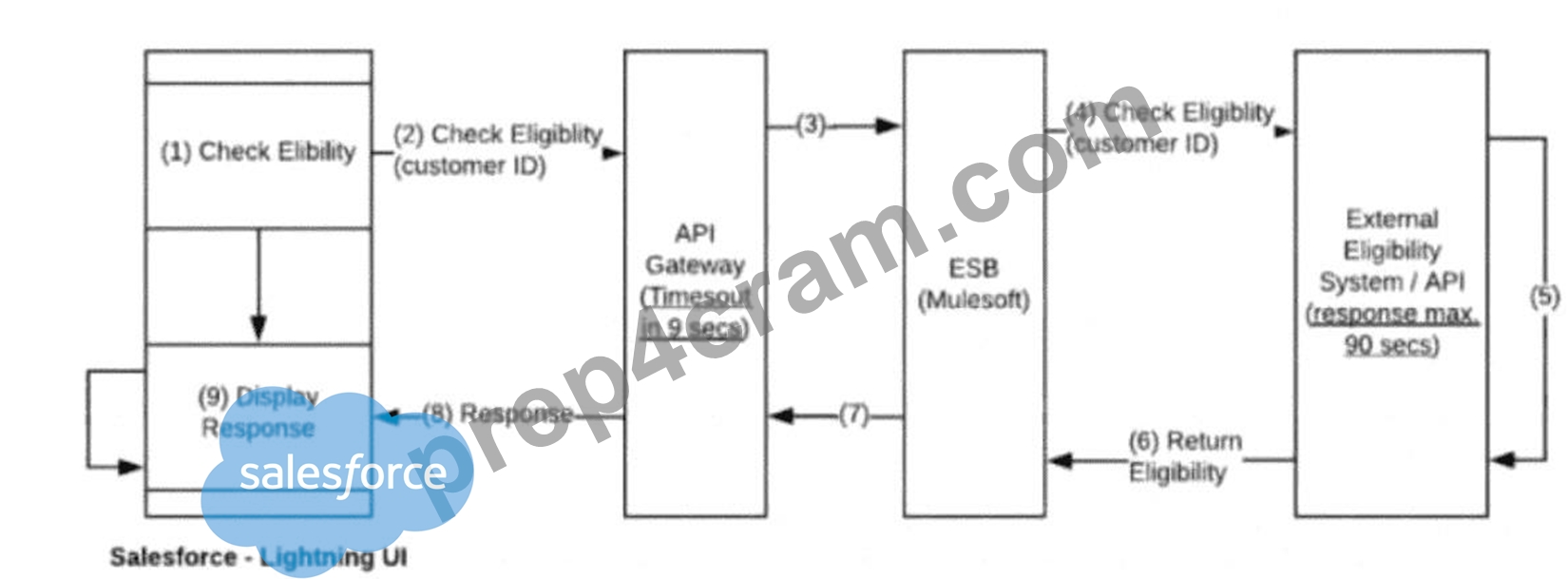
Which recommendation should the integration architect make?
- A. Recommend synchronous Apex callouts from Lightning UI to External Systems via Mule and implement polling on an API Gateway timeout.
- B. Create a platform event in Salesforce via Remote Call-In and use the empAPI in the Lightning UI to serve 3,000 concurrent users when responses are received by Mule.
- C. Use Continuation callouts to make the eligibility check request from Salesforce Lightning UI at page load.
Answer: B
Explanation:
The primary architectural challenge in this scenario is the massive discrepancy between the backend response time (up to 90 seconds) and the API Gateway timeout constraint (9 seconds). In any synchronous integration pattern, the connection must remain open across the entire path; if the API Gateway closes the connection at 9 seconds, a standard Salesforce "Request-Reply" callout will fail long before the 90-second eligibility check is complete.
Option A is non-viable because synchronous polling at a high scale (3,000 concurrent users) would likely hit Salesforce concurrent request limits and place an immense, unnecessary load on the API Gateway. Option B, using Continuation, is designed to handle long-running callouts (up to 120 seconds) without blocking Salesforce threads, but it still requires the external connection path to remain open. It does not bypass the 9- second timeout imposed by the customer's API Gateway.
The optimal recommendation is Option C, which implements an Asynchronous Request-Reply pattern using Platform Events and the empAPI.12
* Request Phase: The Salesforce UI initiates the request. To bypass the 9-second gateway timeout, the ESB (MuleSoft) should be configured to receive the request3 and immediately return an acknowledgment (e.g.,4 HTTP 202 Accepted). This allows the initial Salesforce callout to complete successfully within the 9-second window.56
* Processing Phase: MuleSoft then proceeds with the long-running (up to 90 seconds) call to the external eligibility systems.78
* Callback Phase (Remote Call-In)9: Once the eligibility result is received, MuleSoft calls back into Salesforce via the REST API to publish a Platform Event containing the result.10
* UI Update (empA11PI): The 3,000 sales agents' browsers, having subscribed to the event channel using the empAPI (Lightning's built-in library for streaming events), receive the notification in real- time. The UI then updates to display the "Display Response" step.
This event-driven architecture effectively "insulates" Salesforce and the API Gateway from the backend's high latency, ensures scalability for 3,000 concurrent users, and provides a seamless, real-time user experience without hitting governor limits or timeout constraints.
NEW QUESTION # 39
Universal Containers is a global financial company that sells financial products and services.
There is a daily scheduled Batch Apex job that generates invoice from a given set of orders.
UC requested building a resilient integration for this batch apex job in case the invoice generation fails.
What should an integration architect recommend to fulfill the requirement?
- A. Batch Retry & Error Handling report to monitor the error handling.
- B. Build Batch Retry & Error Handling in the middleware.
- C. Build Batch Retry & Error Handling using BatchApexErrorEvent.
- D. Build Batch Retry & Error Handling in the Batch Apex Job itself.
Answer: C
Explanation:
The BatchApexErrorEvent object allows handling errors that occur during Batch Apex execution. By subscribing to this event,the integration can retry the invoice generation for the failed records or perform other recovery actions. This is a resilient and scalable solution that does not require custom code in the Batch Apex job itself or in the middleware1
NEW QUESTION # 40
When user clicks Check Preferences as part of a Lightning flow in Salesforce, preferences from an externally hosted RESTful service are to be checked in real-time. The RESTful service has OpenAPI 2.0 JSON definitions, responding in data types of Boolean and string values.
Which integration pattern and mechanism should be selected to meet the conditions?
- A. Fire and Forget: Process-driven platform events publishes events on Salesforce Event Bus.
- B. Remote Call-In: Salesforce REST API with REST Composite Resources.
- C. Request-Reply: Enhanced External Services invokes a REST API.
- D. Data Virtualization: Salesforce Connect map data external REST data in external objects.
Answer: C
NEW QUESTION # 41
A company is planning on sending orders from Salesforce to a fulfillment system. The integration architect has been asked to plan for the integration.
Which two questions should the integration architect consider?
Choose 2 answers
- A. Can the fulfillment system implement a contract-first Outbound Messaging interface?
- B. Is the product catalog data identical at all times in both systems?
- C. Can the fulfillment system make a callback into Salesforce?
- D. Can the fulfillment system create new addresses within the Order Create service?
Answer: A,C
Explanation:
Explanation
The integration architect should consider whether the fulfillment system can make a callback into Salesforce and whether it can implement a contract-first Outbound Messaging interface. A callback is a way for the fulfillment system to send a response or an acknowledgment back to Salesforce after receiving an order1. This can help ensure data consistency and reliability between the two systems. A contract-first Outbound Messaging interface is an approach where the integration is designed based on a predefined XML schema that defines the structure and content of the messages2. This can help ensure interoperability and compatibility between the two systems. The other two questions are not relevant for the integration architect to consider. The fulfillment system does not need to create new addresses within the Order Create service, as this is a function of Salesforce3. The product catalog data does not need to be identical at all times in both systems, as long as there is a mapping or synchronization mechanism to handle any discrepancies
NEW QUESTION # 42
An organization needs to integrate Salesforce with an external system and is considering authentication options. The organization already has implemented SAML, using a third-party Identity Provider for integrations between other systems.
Which use case can leverage the existing SAML integration to connect Salesforce with other internal systems?
- A. Make an API inbound integration from an external Java client more secure.
- B. Make formula fields with HYPERLINK() to external web servers more secure.
- C. Make Apex SOAP outbound integrations to external web services more secure.
- D. A Make Apex REST outbound integrations to external web services more secure.
Answer: B
NEW QUESTION # 43
Northern Trail Outfitters (NTO) uses different shipping services for each of the 34 countries it serves. Services are added and removed frequently to optimize shipping times and costs. Sales Representatives serve all NTO customers globally and need to select between valid service(s) for the customer's country and request shipping estimates from that service.
Which two solutions should an architect propose?
Choose 2 answers
- A. Store shipping services in a picklist that is dependent on a country picklist.
- B. Use Platform Events to construct and publish shipper-specific events.
- C. Use middleware to abstract the call to the specific shipping services.
- D. Invoke middleware service to retrieve valid shipping methods.
Answer: C,D
NEW QUESTION # 44
A large business-to-consumer (B2C) customer is planning to implement Salesforce CRM to become a customer-centric enterprise. Below is the B2C customer's current system landscape diagram.
The goals for implementing Salesforce include:
* Develop a 360-degree view of the customer.
* Leverage Salesforce capabilities for marketing, sales, and service processes.
* Reuse Enterprise capabilities built for quoting and order management processes.
Which three systems from the current system landscape can be retired with the implementation of Salesforce?
- A. Sales Activity, Order Management, and Case Management
- B. Order Management, Case Management, and Email Marketing
- C. Email Marketing, Sales Activity, and Case Management
Answer: C
Explanation:
In the framework of a Salesforce Platform Integration Architect's landscape evaluation, the primary goal is to determine the "system of record" for each business function and identify redundancies between legacy systems and the proposed Salesforce architecture. This process is driven by the alignment of Salesforce's native "Customer 360" capabilities with the specific goals defined by the enterprise stakeholders.
According to Goal 2, the customer intends to leverage Salesforce specifically for marketing, sales, and service processes. Within the standard Salesforce ecosystem, these domains are addressed by the three core cloud products:
* Marketing Cloud provides the capabilities found in the legacy Email Marketing System.
* Sales Cloud replaces the functions of the Sales Activity System.
* Service Cloud is the native replacement for the Case Management System.
By migrating these three domains to a single platform, the organization directly fulfills Goal 1-developing a
360-degree view of the customer. Consolidating these interactions onto the Salesforce platform allows for a unified data model where customer behaviors in marketing, sales, and support are visible in one place, eliminating the silos inherent in the previous landscape.
However, a critical constraint is presented in Goal 3, which explicitly mandates the reuse of existing enterprise capabilities for quoting and order management. In an integration architecture, this signals that the Quoting System and Order Management System (OMS) are designated as external systems of record that must remain active. These systems often contain complex logic, tax calculations, or supply chain integrations (such as with an SAP Business Suite) that the business is not currently ready to migrate.
Therefore, since the Quoting and Order Management systems must be retained, they are excluded from the retirement list. The remaining three systems-Email Marketing, Sales Activity, and Case Management- overlap with Salesforce's native strengths and are not protected by the "reuse" requirement. Retiring them streamlines the technology stack and allows the architect to focus on building robust integration patterns (such as REST or SOAP callouts) to connect Salesforce to the retained Quoting and Order Management systems.
NEW QUESTION # 45
A company needs to send data from Salesforce to a homegrown system behind a corporate firewall. The data is pushed one way, doesn't need to be real-time, and averages 2 million records per day. What should an integration architect consider?
- A. Due to high volume of records, the external system will need to use a BULK API Rest endpoint to connect to Salesforce.
- B. Due to high volume of records, a third-party integration tool is required to stage records off platform.
- C. Due to high volume of records, number of concurrent requests can hit the limit for the REST API.
Answer: B
Explanation:
With a volume of 2 million records per day, this integration exceeds the practical limits of standard near- real-time patterns like Outbound Messaging or synchronous Apex Callouts. Sending 2 million individual REST requests would likely exhaust the daily API limit and could cause significant performance degradation in Salesforce due to transaction overhead.
An Integration Architect must recommend an Asynchronous Batch Data Synchronization pattern, typically facilitated by a third-party ETL/Middleware tool (e.g., MuleSoft, Informatica, or Boomi). Staging the records off-platform is essential for several reasons:
* Throttling: The homegrown system behind a firewall may not be able to handle a massive, sudden burst of 2 million records. A middleware tool can ingest the data from Salesforce and "drip-feed" it into the target system at an acceptable rate.
* Error Handling and Retries: Middleware provides sophisticated persistence and "Dead Letter Queues" to ensure that if the homegrown system goes offline, no data is lost.
* API Efficiency: The middleware can use the Salesforce Bulk API 2.0 to extract the data in large chunks, which is significantly more efficient than individual REST calls and consumes far fewer API limits.
Option A is a valid concern but is a symptom of the wrong choice of tool (REST). Option B describes an inbound integration to Salesforce, whereas the requirement is outbound. By utilizing a third-party tool to stage and manage the 2 million record flow, the architect ensures that the integration is scalable, respects the corporate firewall constraints (via a secure agent or VPN), and maintains the performance of the Salesforce production environment.
NEW QUESTION # 46
Universal Containers (UC) is currently managing acustom monolithic webservice that runs on an on-premise server.
This monolithic web service is responsible for Point-to-Point (P2P) integrations between:
1. Salesforce and a legacy billing application
2. Salesforce and a cloud-based Enterprise Resource Planning application
3. Salesforce and a data lake.
UC has found that the tight interdependencies between systems is causing integrations to fail.
What should an architect recommend to decouple the systems and improve performance of the integrations?
- A. Move thecustom monolithic web service from on-premise to a cloud provider.
- B. Leverage modular design by breaking up the web service into smaller pieces for a microservice architecture.
- C. Use the Salesforce Bulk API when integrating back into Salesforce.
- D. Re-write and optimize the current web service to be more efficient.
Answer: B
Explanation:
A microservice architecture is a way of designing software applications as a collection of loosely coupled services, each of which implements a specific business function.Microservices enable modularity, scalability, and agility in software development, as well as easier testing and deployment. By breaking up the monolithic web service into smaller pieces, each responsible for a single integration, UC can decouple the systems and improve the performance of the integrations. For example, UC can use Salesforce Platform Events to publish and subscribe to events from Salesforce to the legacy billing application, the ERP application, and the data lake. This way, UC can avoid point-to-point integrations and leverage an event-driven architecture that reduces coupling and increases reliability12.
The other options are not as effective as option B. Option A does not address the root cause of the tight interdependencies between systems, and may not result in significant performance improvement. Option C may improve the throughput of data loading into Salesforce, but it does not solve the problem of coupling between systems. Option D mayreduce the latency and maintenance costs of the web service, but it does not change the design of the web service or the integrations.
References: 1: Microservice Architectures With Sales and Service Cloud - Salesforce Live 2: 6 Fundamental Principles of Microservice Design | Salesforce
NEW QUESTION # 47
A conglomerate is designing a Lightning Web Component (LWC) to display transactions aggregated from different sources. Their current system landscape is as follows:
1. Transactions are created at any time through their various on-premise and cloud-based systems.
2. All necessary transactions are replicated to a custom Transaction object in Salesforce. It is updated periodically so it only has a subset of the necessary transactions between updates.
3. Middleware supports publish-subscribe interactions and provides RESTful Enterprise APIs that can retrieve transactions from on-premise and cloud-based systems.
The company wants to address a usability concern regarding incomplete data displayed on the LWC component. What should the Integration Architect specify so the LWC will be able to display all the required transactions?
- A. Publish a Platform Event, have the middleware subscribe and update the custom object on receipt of Platform Event.
- B. Let the Lightning Data Service with an wire adapter display new values when the custom object records change.
- C. Call the Enterprise APIs directly from the LWC's JavaScript code and redisplay the LWC on receipt of the API response.
- D. Use the Continuation class to call the Enterprise APIs and then process the response in a callback method.
Answer: C
NEW QUESTION # 48
Northern Trail Outfitters needs to make synchronous callouts "available to promise" services to query product availability and reserve inventory during customer checkout process.
Which two considerations should an integration architect make when building a scalable integration solution?
Choose 2 answers
- A. How many concurrent service calls are being placed.
- B. The typical and worst-case historical response times.
- C. The maximum query cursors open per user on the service.
- D. The number batch jobs that can run concurrently.
Answer: C,D
NEW QUESTION # 49
Universal Containers (UC) is currently managing a custom monolithic web service that runs on an on-premise server.
This monolithic web service is responsible for Point-to-Point (P2P) integrations between:
1. Salesforce and a legacy billing application
2. Salesforce and a cloud-based Enterprise Resource Planning application
3. Salesforce and a data lake.
UC has found that the tight interdependencies between systems is causing integrations to fail.
What should an architect recommend to decouple the systems and improve performance of the integrations?
- A. Move the custom monolithic web service from on-premise to a cloud provider.
- B. Leverage modular design by breaking up the web service into smaller pieces for a microservice architecture.
- C. Use the Salesforce Bulk API when integrating back into Salesforce.
- D. Re-write and optimize the current web service to be more efficient.
Answer: B
NEW QUESTION # 50
Acustomer imports data from an external system into Salesforce using Bulk API. These jobs have batch sizes of 2000 and are run in parallel mode. The batch fails frequently with the error "Max CPU time exceeded". A smaller batch size will fix this error.
Which two options should be considered when using a smaller batch size?
Choose 2 answers
- A. Smaller batch size can trigger "Too many concurrent batches" error.
- B. Smaller batch size may exceed theconcurrent API request limits.
- C. Smaller batch size may increase time required to execute bulk jobs.
- D. Smaller batch size may cause record-locking errors.
Answer: C,D
Explanation:
The error "Max CPU time exceeded" occurs when a batch of records takes more than 10 minutes to process in the Bulk API. Using a smaller batch size can reduce the processing time and avoid this error. However, there are some trade-offs to consider when using a smaller batch size, such as:
Answer A is valid because a smaller batch size may cause record-locking errors if multiple batches try toupdate the same records or records that are related by a lookup or master-detail relationship. This can result in concurrency issues and data inconsistency1 Answer B is valid because a smaller batch size may increase the time required to executebulk jobs, as more batches need to be created and processed sequentially. This can affect the performance and efficiency of the integration1 Answer C is not valid because a smaller batch size may not exceed the concurrent API request limits, as the Bulk API does not count against the concurrent request limit. TheBulk API has its own limit on the number ofbatches that can be queued or in progress, which is 5,000 per rolling 24-hour period2 Answer D is not valid because a smaller batch size can trigger "Too many concurrent batches" error only if the number of batches exceeds the limit of 5,000 per rolling 24-hour period. Thiserror is not related to the parallel mode of the Bulk API, which allows up to 10 batches to be processed simultaneously
NEW QUESTION # 51
An Architect is required to integrate with an External Data Source via a Named Credential with an Apex callout due to technical constraints.
How is authentication achieved?
- A. Connect via Communities.
- B. Handle authentication in the code.
- C. Handle authentication with login flows.
- D. Connect via Salesforce Connect.
Answer: B
Explanation:
The authentication is achieved by handling it in the code. A Named Credential is a type of metadata that specifies the URL of a calloutendpoint and its required authentication parameters. An Apex callout is a way to invoke anexternal web service or API from Apex code. When using a Named Credential with an Apex callout, the authentication is handled by the Apex code that invokes the callout. The Apex code can use the HttpRequest class to set the endpoint, method, headers, and body of the callout request, and use the Http class to send the request and receive the response. The Apex code can also use the NamedCredential class to access the properties of the Named Credential, such as the principal type, protocol, and credential type. Handling authentication with login flows is not a valid option because login flows are a way to customize the user login process in Salesforce, not for external web services or APIs. Connecting via Salesforce Connect or Communities is not a valid option because they are not related to Apex callouts or Named Credentials.
NEW QUESTION # 52
A company has an external system that processes and tracks orders. Sales reps manage their leads and opportunity pipeline in Salesforce. In the current state, the two systems are disconnected and processing orders requires a lot of manual entry on sales rep part. This creates delays in processing orders and incomplete data due to manual entry.
As a part of modernization efforts the company decided to integrate Salesforce and the order management system. The following technical requirements were identified:
1. Orders need to be created in real time from salesforce
2. Minimal customization*, and code should be written due to a tight timeline and lack of developer resources
3. Sales reps need to be able to see order history and be able to see most up to date information on current order status.
4. Managers need to be able to run reports in Salesforce to see daily and monthly order volumes and fulfillment timelines.
5. The legacy system is hosted on premise and is currently connected to the Enterprise Service Bus (ESB). The ESB is flexible enough to provide any methods and connection types needed by salesforce team.
6. There are 1000 sales reps. Each user processes/creates on average 15 orders per shift. Most of the orders contain 20-30 line items.
How should an integration architect integrate the two systems based on the technical requirements and system constraints?
- A. Use Salesforce big object, SOAP API and Dataloader.
- B. Use Salesforce external object and OData connector.
- C. Use Salesforce custom object, custom REST API and ETL.
- D. Use Salesforce standard object, REST API and ETL.
Answer: D
NEW QUESTION # 53
A company that is a leading provider of training delivers courses to students globally. The company decided to use customer community in order to allow Studer to log in to the community, register for courses and pay course fees. The company has a payment gateway that takes more than 30 seconds to process the pays transaction. Students would like to get the payment result in real-time so in case an error happens, the students can retry the payment process.
What is the recommended integration approach to process payments based on this requirement?
- A. Use request and reply to make an API call to the payment gateway.
- B. Use platform event to process payment to the payment gateway.
- C. Use continuation to process payment to the payment gateway.C Use change data capture to process payment to the payment gateway.
Answer: C
Explanation:
Explanation
The continuation class in Apex allows you to make long-running requests to external web services and process their responses in a callback method. This is useful for scenarios where the response time exceeds the normal Apex limits, such as 10 seconds for synchronous transactions or 120 seconds for asynchronous transactions. By using continuation, you can avoid hitting these limits and provide a better user experience1 References: Callout Limits and Limitations
NEW QUESTION # 54
......
Updated Integration-Architect Dumps Questions For Salesforce Exam: https://pass4sure.prep4cram.com/Integration-Architect-exam-cram.html
