

Best AB-730 Exam Dumps for the Preparation of Latest AB-730 Exam Questions
Download Latest & Valid Questions For Microsoft AB-730 exam
NEW QUESTION # 18
You are a project coordinator for a small consulting firm.
You are responsible for tracking client communications, managing project timelines, and preparing weekly status updates for internal stakeholders.
You have a Microsoft 365 Copilot license.
You create an agent to help you monitor project milestones, follow up on client emails, and generate weekly summary reports.
With whom can you share the agent?
- A. only Microsoft Teams channel members
- B. the people in your organization and people that have personal Microsoft accounts
- C. only the people in your organization
- D. any person who has a valid email address
Answer: C
Explanation:
Microsoft 365 Copilot agents operate within the security, compliance, and identity boundaries of a Microsoft 365 tenant. Custom agents created in the Microsoft 365 Copilot app are governed by organizational policies, role-based access control, and Microsoft Entra ID authentication.
According to Microsoft AI Business Professional guidance, Copilot agents are designed for enterprise use and are shared within the organization unless administrators configure broader sharing capabilities. External sharing with personal Microsoft accounts or arbitrary email addresses is not supported by default due to security, data protection, and compliance requirements.
Because the agent in this scenario interacts with organizational data such as client emails, project milestones, and internal reports, access must remain restricted to authenticated users within the same tenant. This ensures that sensitive business information remains protected and that data access respects existing permissions.
Therefore, the agent can be shared only with people in your organization, making option D the correct answer.
NEW QUESTION # 19
You have a Microsoft 365 subscription.
You do NOT have a Microsoft 365 Copilot license.
For each of the following statements, select Yes if the statement is true. Otherwise, select No.
NOTE: Each correct selection is worth one point.
Answer:
Explanation:
NEW QUESTION # 20
You are using Microsoft 365 Copilot to plan a trip and have asked Copilot to remember several details about the trip.
You cancel the trip plans.
You need to ensure that Copilot forgets the details.
What should you do?
- A. From Copilot delete memories.
- B. From the My Account portal, delete the Copilot activity history.
- C. From Copilot delete custom instructions.
- D. From Copilot delete all the conversation about the trip.
Answer: A
Explanation:
Microsoft 365 Copilot includes a memory capability that allows it to retain user-provided preferences or details across interactions when explicitly instructed to remember them. These stored details are referred to as memories and are separate from standard conversation history.
If you previously asked Copilot to remember specific trip-related details, those details are stored as structured memory items. Simply deleting the conversation does not necessarily remove stored memory entries.
Likewise, deleting activity history through the My Account portal removes conversation records but does not directly manage structured Copilot memories. Custom instructions define persistent behavioral preferences and are unrelated to trip-specific stored data.
To ensure Copilot no longer retains those trip details, you must delete the stored memories directly within Copilot. Microsoft documentation explains that users can view and manage saved memories and remove them individually to control what Copilot retains.
Therefore, the correct action to ensure Copilot forgets the trip details is to delete the memories.
NEW QUESTION # 21
A colleague from another company shares a link to a prompt.
When you select the link, you receive the following response: "Prompt not found. Sorry, it looks like the prompt is no longer available." What is a possible cause of the response?
- A. The prompt is a scheduled prompt.
- B. The prompt contains a file that has a sensitivity label applied.
- C. The prompt contains a reference to a file that you do NOT have access to.
- D. The prompt is outdated.
- E. The prompt is outside of your organization.
Answer: E
Explanation:
Microsoft 365 Copilot operates within the security, compliance, and identity boundaries of a Microsoft 365 tenant. Shared prompts, prompt links, and Copilot artifacts are governed by organizational access controls and tenant isolation. If a prompt is created and shared from outside your organization, cross-tenant access may not be supported depending on the sharing configuration and administrative policies.
When a user attempts to open a prompt that resides in another organization's tenant without proper cross- tenant sharing permissions, Copilot cannot locate or validate the resource within the user's own environment.
As a result, the system displays a "Prompt not found" message.
Option B would typically result in an access or permissions error rather than the prompt being unavailable entirely. Sensitivity labels and scheduled prompts do not inherently cause a "not found" error. Therefore, the most likely cause is that the prompt exists outside your organization's tenant boundary and is not accessible to you.
NEW QUESTION # 22
You are creating a custom analytics agent in the Microsoft 365 Copilot app. The agent will use Microsoft Excel files that contain sales data as knowledge.
You need to ensure that the agent can create visualizations, perform mathematical operations, create aggregations, and analyze the data in the files.
What should you add to the agent?
- A. a template
- B. code interpreter
- C. a suggested prompt
- D. image generator
Answer: B
Explanation:
When building a custom analytics agent in Microsoft 365 Copilot that must process structured data from Excel files, advanced analytical capabilities are required. According to Microsoft AI Business Professional guidance, tasks such as performing mathematical calculations, generating aggregations, creating charts, and conducting structured data analysis require programmatic execution capabilities rather than simple text generation.
A code interpreter enables the agent to run Python-based analytical operations in a secure execution environment. This allows the agent to manipulate datasets, compute totals and averages, perform grouping and filtering, and generate visualizations such as bar charts or line graphs based on the Excel data. The interpreter bridges the gap between natural language instructions and executable analytical logic.
An image generator is designed for creative visual content and is unrelated to structured data analytics.
Suggested prompts and templates improve usability and consistency but do not provide computational or visualization capabilities.
Therefore, to enable mathematical operations, aggregation, data analysis, and visualization of Excel sales data, the correct component to add to the agent is a code interpreter.
NEW QUESTION # 23
You use Microsoft 365 Copilot.
You regularly upload the same five files to Copilot chats.
You need to simplify referencing the files in the chats.
What are two ways to achieve the goal?
- A. Send a prompt that includes the files, and then save the prompt.
- B. Create an agent that has a knowledge source.
- C. Create a notebook that references the files.
- D. Zip the documents and upload the ZIP file to the chats.
- E. Ask the data engineers to create a fine-tuned model.
Answer: B,C
Explanation:
Microsoft 365 Copilot provides structured ways to persist and reuse knowledge sources to avoid repeatedly uploading the same files.
Creating a notebook that references the five files (Option B) allows those documents to remain attached within a persistent workspace. Copilot can then consistently ground responses in those files without re-uploading them for every conversation.
Creating an agent with a defined knowledge source (Option D) also provides a reusable solution. By configuring the five files as part of the agent's knowledge base, the agent can automatically reference them in future interactions.
Saving a prompt does not persist file attachments. Fine-tuning models is not part of standard Microsoft 365 Copilot user workflows. Uploading a ZIP file does not improve reference management and may reduce accessibility of individual documents.
Therefore, the correct solutions are to create a notebook that references the files and to create an agent with a knowledge source.
NEW QUESTION # 24
You sign in to the Microsoft 365 Copilot app by using your work account as shown in the following exhibit
A colleague tells you that when they open the Microsoft 365 Copilot app, they have access to the Researcher agent. You need to access to the Researcher agent.
What should you do?
- A. Select Explore agents and then search for Researcher.
- B. From Microsoft Edge, use your work account to sign in to https://copilot.microsoft.com.
- C. Request a Microsoft 365 Copilot license from an administrator.
- D. Sign in to the Copilot app by using a personal account
Answer: A
Explanation:
In Microsoft 365 Copilot, agents such as Researcher are accessed through the Agents experience within the Copilot app. If the user interface does not immediately display a specific agent, the correct action is to browse or search the available agents catalog. The exhibit shows the left navigation pane with an Explore agents option.
According to Microsoft AI Business Professional guidance, built-in and custom agents can be discovered and enabled through the Explore agents section. If the user already has the appropriate Copilot license and is signed in with their work account, there is no need to switch accounts or request another license.
Signing in through a browser does not change feature availability, and using a personal account would remove access to organizational features. Therefore, to access the Researcher agent, you should select Explore agents and search for Researcher.
NEW QUESTION # 25
A colleague from another company shares a link to a prompt.
When you select the link, you receive the following response: "Prompt not found. Sorry, it looks like the prompt is no longer available."
What is a possible cause of the response?
- A. The prompt is a scheduled prompt.
- B. The prompt contains a file that has a sensitivity label applied.
- C. The prompt contains a reference to a file that you do NOT have access to.
- D. The prompt is outdated.
- E. The prompt is outside of your organization.
Answer: E
Explanation:
Microsoft 365 Copilot operates within the security, compliance, and identity boundaries of a Microsoft 365 tenant. Shared prompts, prompt links, and Copilot artifacts are governed by organizational access controls and tenant isolation. If a prompt is created and shared from outside your organization, cross-tenant access may not be supported depending on the sharing configuration and administrative policies.
When a user attempts to open a prompt that resides in another organization's tenant without proper cross-tenant sharing permissions, Copilot cannot locate or validate the resource within the user's own environment. As a result, the system displays a "Prompt not found" message.
Option B would typically result in an access or permissions error rather than the prompt being unavailable entirely. Sensitivity labels and scheduled prompts do not inherently cause a "not found" error. Therefore, the most likely cause is that the prompt exists outside your organization's tenant boundary and is not accessible to you.
NEW QUESTION # 26
You have a Microsoft 365 Copilot license.
You plan to run several prompts.
What should you use to ensure that Copilot generates the best response for each prompt? More than one answer choice may achieve the goal. To answer, select the Best options in the answer area.
NOTE: Each correct selection is worth one point.
Answer:
Explanation: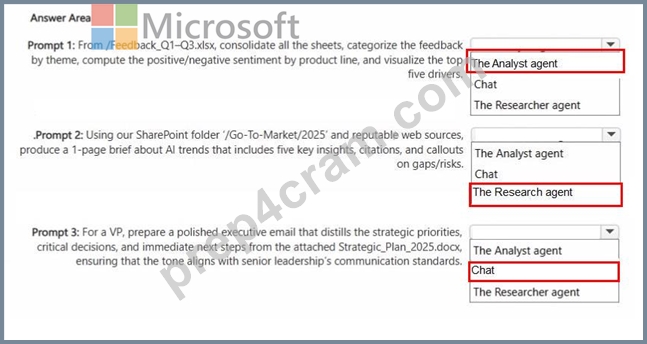
NEW QUESTION # 27
Select the answer that correctly completes the sentence.
Answer:
Explanation:
NEW QUESTION # 28
For each of the following statements, select Yes if the statement is true. Otherwise, select No. NOTE: Each correct selection is worth one point.
Answer:
Explanation:
Explanation:
Microsoft 365 Copilot can use Microsoft Graph-grounded data (based on the user's permissions) to help users work with Microsoft 365 content. This includes surfacing and summarizing information from Teams chats, so statement 1 is true. Copilot can also summarize and generate content related to Teams meetings (for example, meeting recap details, key discussion points, and follow-up actions when meeting artifacts such as transcript/notes are available), and it can answer questions and draft related content-so statement 3 is true.
Statement 2 is false because, while Copilot can draft emails and help prepare messages, it does not independently schedule and send emails automatically "based on conditions" as a native Copilot function.
Conditional sending is typically handled through workflow automation tools (for example, Power Automate) and still requires appropriate configuration, permissions, and governance. In enterprise environments, this separation helps reduce risk by ensuring that automated outbound communication remains controlled, auditable, and compliant.
NEW QUESTION # 29
For each of the following statements, select Yes if the statement is true. Otherwise, select No. NOTE: Each correct selection is worth one point.
Answer:
Explanation:
NEW QUESTION # 30
You have a Microsoft Excel workbook open that contains a table. The table contains sales data and the following columns:
* OrderDate
* OrderNumber
* Amount
You plan to use Microsoft Copilot in Excel to generate a monthly summary of the sales data in the table.
What should you include in the prompt to generate an effective summary? More than one answer choice may achieve the goal. Select the BEST answer.
- A. a specific cell range from the worksheet
- B. a formula to calculate monthly totals
- C. the clear goal of the summary
- D. the file name of the workbook
- E. the desired format of the response
Answer: C,E
Explanation:
Comprehensive and Detailed 150 to 200 words of Explanation Microsoft AI Business professional documents:
To generate an effective monthly summary with Copilot in Excel, Microsoft prompting guidance emphasizes two core elements: clear intent and expected output structure. First, you should state the goal explicitly- such as "summarize total sales by month based on OrderDate and Amount, and highlight month-over-month changes." This directs Copilot to the correct aggregation and analysis behavior (Option D).
Second, specifying the desired format improves usability and reduces ambiguity. For example, requesting "a table with Month, Total Sales, Number of Orders, and Average Order Value" or "a bulleted executive summary plus a small summary table" ensures Copilot returns results in a format you can immediately use (Option A).
A specific cell range (Option B) is usually unnecessary when the data is already in a recognized Excel table, because Copilot can work from the table context. The workbook file name (Option C) does not help analysis.
Providing a formula (Option E) is not required because Copilot can compute monthly totals; formulas are optional if you want a specific calculation method, but they are not the best prompt ingredients for an effective summary.
Therefore, the best answers are A and D.
NEW QUESTION # 31
You create an agent in the Microsoft 365 Copilot app by using a template.
For each of the following statements, select Yes if the statement is true. Otherwise, select No.
NOTE: Each correct selection is worth one point.
Answer:
Explanation:
NEW QUESTION # 32
You are discussing Microsoft 365 Copilot with a colleague. The colleague asks which data Copilot uses to answer questions when using the Work scope.
What should you tell your colleague?
- A. Copilot provides responses based only on data that the user can access.
- B. Copilot provides responses based only on the general knowledge that Copilot was trained on.
- C. Copilot provides responses based only on data that the user can access and the general knowledge that Copilot was trained on.
- D. Copilot provides responses based on all the data in your organization's Microsoft 365 environment and the general knowledge that Copilot was trained on.
Answer: C
Explanation:
Microsoft 365 Copilot operates within two primary knowledge boundaries: its foundational large language model training data and the organizational data available within the Microsoft 365 tenant. However, Copilot strictly enforces Microsoft's security and compliance model, meaning it only retrieves and uses data that the signed-in user is authorized to access.
When using the Work scope, Copilot combines the general knowledge it was trained on with organizational data such as documents, emails, chats, calendars, and files stored in Microsoft 365. Importantly, Copilot respects role-based access control and existing permissions. It does not surface information from content the user does not have access to.
Option A is incomplete because Work scope includes organizational data. Option B is incorrect because Copilot does not access all tenant data indiscriminately; it is permission-scoped. Option D is incomplete because Copilot also leverages its general training knowledge.
Therefore, the correct explanation is that Copilot provides responses based only on data the user can access, combined with its general training knowledge.
NEW QUESTION # 33
For each of the following statements, select Yes if the statement is true. Otherwise, select No.
NOTE: Each correct selection is worth one point.
Answer:
Explanation:
Explanation:
Microsoft 365 Copilot is designed to be helpful by using work context-for example, the files you have access to, recent activity, meetings, emails, and SharePoint/OneDrive content-to suggest relevant prompts and help you start tasks faster. It also uses this context to augment your prompt before it is sent to the LLM.
This is the grounding approach (often described as retrieval-augmented generation): Copilot retrieves relevant organizational content you're permitted to access and adds it as supporting context so responses are accurate and business-relevant. However, Microsoft 365 Copilot does not use your organization's contextual data to train the underlying foundation model. That separation is critical for enterprise privacy and compliance:
your prompts, responses, and tenant data are used to generate the answer for your session and permissions, but are not used to improve or retrain the base LLM. This approach supports responsible AI, protects confidential business information, and ensures outputs respect access controls.
NEW QUESTION # 34
......
Exam Materials for You to Prepare & Pass AB-730 Exam: https://pass4sure.prep4cram.com/AB-730-exam-cram.html
