

[Aug-2026] Feel Pure Storage FlashArray-Storage-Professional Dumps PDF Will likely be The best Option
FlashArray-Storage-Professional exam torrent Pure Storage study guide
Pure Storage FlashArray-Storage-Professional Exam Syllabus Topics:
| Topic | Details |
|---|---|
| Topic 1 |
|
| Topic 2 |
|
| Topic 3 |
|
| Topic 4 |
|
| Topic 5 |
|
NEW QUESTION # 37
A storage administrator has presented VMFS datastores from a FlashArray with 10TB of raw capacity.
Why would the administrator see system space when logging in to the FlashArray GUI?
- A. More than 2TB of volume snapshots were destroyed.
- B. Virtual machines have not yet issued an unmap command.
- C. There is more than 2TB of reclaimable space on the FlashArray.
Answer: C
Explanation:
On a Pure Storage FlashArray, "System Space" is a specific GUI-reported metric. Purity has a predefined, hidden internal space budget-typically around 20% of the raw mapped capacity (which would be 2TB on a 10TB array)-reserved for internal array operations. This budget covers RAID/parity overhead, metadata, and reclaimable space (data from deleted volumes, snapshots, or overwritten blocks that are waiting for the backend garbage collection process to fully erase them from the flash chips).
Normally, this internal overhead stays below the 20% budget, and "System Space" displays as 0.00 in the GUI. However, if an administrator deletes a massive amount of data at once, causing the reclaimable space to exceed that 2TB budget, the overflow is prominently displayed in the GUI as "System Space." Here is why the other options are incorrect:
Virtual machines have not yet issued an unmap command (A): If a VMware VM deletes a file but the OS hasn't issued an UNMAP/TRIM command, the FlashArray is completely unaware that the data was deleted. Therefore, the array continues to report that capacity as standard Volume Space, not System Space.
More than 2TB of volume snapshots were destroyed (C): While destroying snapshots leads to reclaimable space, "reclaimable space" (Option B) is the specific, correct Purity architectural term and metric that the system uses to calculate the internal budget threshold.
NEW QUESTION # 38
What happens when you demote the original source pod?
- A. It saves a temporary copy of the source pod content in the eradication bin.
- B. Replication is paused.
- C. Replication is reversed.
Answer: C
Explanation:
ActiveCluster and Pod Roles: In a Pure Storage ActiveCluster or ActiveDR environment, a Pod is a management container for volumes. To move workloads or perform a planned failover between two arrays, you use the Promote and Demote commands.
The Reversal Process: When you have two pods in a replication relationship (Source and Target), data flows from the Promoted (Active/Source) pod to the Demoted (Passive/Target) pod.
When you Demote the current source, it transitions from a "read-write" state to a "read-only" (passive) state.
If the other pod in the pair is then Promoted, Purity automatically intelligently reverses the direction of replication. The array that was previously receiving data now begins sending incremental updates back to the original source.
Continuous Protection: This design ensures that you don't have to manually tear down and recreate replication schedules every time you switch production sites. The system tracks the metadata changes and ensures that only the delta (changed blocks) are sent in the new direction.
Why Option C is incorrect: If replication were simply paused, the two sites would quickly drift out of sync, making it impossible to fail back without a full baseline resync.
Why Option A is incorrect: Demoting a pod does not delete any data; it simply changes the access characteristics and replication role. The data remains fully intact on the storage media.
NEW QUESTION # 39
Where can a snapshot be copied out to?
- A. A new volume or new Snapshot
- B. A new volume or existing volume
- C. An existing volume or new Snapshot
Answer: B
Explanation:
On a Pure Storage FlashArray, volume snapshots are immutable, read-only, point-in-time representations of your data. Because they cannot be attached directly to a host to be read or modified, you must use the Copy function to make the data usable.
The Purity operating environment allows you to copy a snapshot to two specific destinations:
A new volume: This effectively creates a clone. It provisions a brand-new, writable volume using the exact data footprint of the snapshot. This is incredibly useful for test/dev environments, offline reporting, or granular file recovery where you don't want to disrupt the original production volume.
An existing volume: This takes the data from the snapshot and completely overwrites the target volume. This is the standard procedure when you need to perform a full rollback of a corrupted volume, or when you want to quickly refresh a lower-level environment (like refreshing a QA database with yesterday's Production snapshot).
Here is why the other options are incorrect:
A new Snapshot (B & C): You cannot directly "copy" a snapshot to create another standalone snapshot. Snapshots are uniquely generated from active volumes. If you wanted to duplicate a snapshot's exact state, you would first copy it to a volume, and then take a new snapshot of that resulting volume.
NEW QUESTION # 40
Which FA File Directory Services statement is correct?
- A. FA File uses all network interfaces for DNS and directory service communication.
- B. FA File uses management interfaces as default for directory service communication.
- C. FA File uses file service interfaces as default for directory service communication.
Answer: C
Explanation:
Interface Separation: Pure Storage FlashArrays distinguish between Management traffic (used for the GUI, CLI, and Pure1 connectivity) and Data traffic (used for host connectivity). Within the data path, File Service Interfaces are the logical interfaces assigned to handle NFS and SMB traffic.
Directory Service Communication: For FA File to function, it must communicate with external identity providers (like Microsoft Active Directory or OpenLDAP) to authenticate users and resolve permissions.
The Default Path: By design, Purity prioritizes the File Service Interfaces for these lookups. This is because the directory servers (Domain Controllers) are typically located on the same production/data network as the clients accessing the files. Using the File Service Interface ensures that authentication traffic follows the same network path and security rules as the data traffic itself.
Why Option B is incorrect: While the array management plane can use the management interfaces for its own administrative LDAP/SAML logins, the File Services component defaults to the data-path (File) interfaces to avoid "crossing the streams" between management and production data networks.
Why Option C is incorrect: Purity is very specific about its routing tables. It does not blindly use "all" interfaces for DNS/Directory services. If a File Service interface is configured and active, it becomes the primary egress point for file-related metadata and authentication requests.
NEW QUESTION # 41
Refer to the exhibit: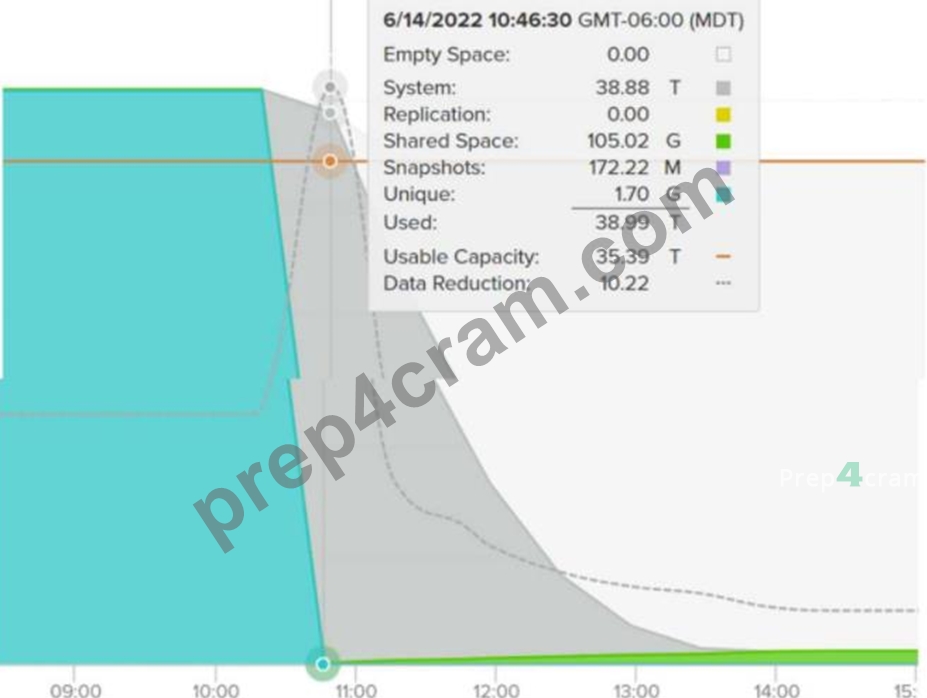
What is the most likely cause of system space in this capacity graph?
- A. Large volume destroyed and eradicated.
- B. Space reclamation stopped working properly.
- C. SafeMode was enabled on the system.
Answer: A
Explanation:
Analyzing the Graph: The provided capacity graph shows a sharp, vertical drop in Unique and Shared space (the teal/green sections) at approximately 10:45. Simultaneously, there is a massive spike in System space (the grey shaded area).
The "System" Space Spike: In Purity, when a volume is deleted and eradicated, the data isn't physically wiped from the flash modules instantly. Instead, the logical references are removed, and the blocks are moved into a "Pending Reclamation" state. In older versions of Purity reporting (or specific views), this pending work is often categorized under System space until the background Garbage Collection (GC) process can physically reclaim it.
The Decay Curve: Notice the grey "System" area gradually tapers down over the following hours (from 11:00 to 14:00). This is the visual representation of the array's Garbage Collection engine working in the background to physically free up those blocks.
Why Option C is incorrect: If SafeMode were enabled, the space would not move into "System" space in this manner; it would remain locked in the Snapshots or Destroyed bucket for the duration of the retention period, preventing the graph from dropping at all.
Why Option A is incorrect: If space reclamation stopped working, the grey "System" area would stay flat and would not decay over time. The fact that it is trending downward proves that reclamation is actively processing the deleted volume.
NEW QUESTION # 42
An administrator is running commands to verify NVME/TCP connectivity from the hosts to the FlashArray. They use the command ping -M do -s 8972 <ip_addr> from the initiator and it fails.
What should the administrator do to resolve the issue?
- A. Run the command from the target.
- B. Engage support to enable NVME/ TCP services.
- C. Check the MTU of 9000 is set on each hop to the FA.
Answer: C
Explanation:
When configuring NVMe/TCP (or iSCSI) for optimal performance on a Pure Storage FlashArray, configuring Jumbo Frames (an MTU of 9000) end-to-end is a standard best practice.
The command ping -M do -s 8972 <ip_addr> is specifically used to verify Jumbo Frame configuration across the network.
The -M do flag sets the "Do Not Fragment" (DF) bit, meaning the network is not allowed to break the packet into smaller pieces.
The -s 8972 flag sets the ICMP data payload to 8972 bytes. When you add the standard 8-byte ICMP header and the 20-byte IP header, the total packet size equals exactly 9000 bytes.
If this ping command fails, it indicates that somewhere along the network path between the host (initiator) and the FlashArray (target), a switch port, router, or network interface is not configured to support an MTU of 9000. The packet is being dropped because it is too large and cannot be fragmented. The administrator must verify the MTU settings on every network hop (switches, routers, and host NICs) to resolve the issue.
Here is why the other options are incorrect:
Engage support to enable NVME/ TCP services (A): The failure of a Jumbo Frame ping test is a Layer 2/Layer 3 network configuration issue, not an indicator that the NVMe/TCP storage protocol service is disabled on the array.
Run the command from the target (C): While pinging from the FlashArray back to the host is a valid secondary troubleshooting step, it will likely also fail if the network path doesn't support Jumbo Frames. The actual resolution is to fix the MTU on the network hops.
NEW QUESTION # 43
A FlashArray//C R4 has ports Eth0 and Eth1 connected to a switch using 100Gb/s Direct Attach Copper (DAC) cables. The administrator is unable to configure these ports for iSCSI services.
Why is this occurring?
- A. The DAC cables are not compatible with the array's ports.
- B. The ports are designated for Management connectivity.
- C. The ports are designated for DirectFlash Shelf connectivity.
Answer: C
Explanation:
On the Pure Storage FlashArray//C R4 (as well as the //XL and //E series architectures), the onboard 100Gb/s Ethernet LOM (LAN on Motherboard) ports-specifically eth0 and eth1-are purpose-built and strictly reserved for DirectFlash Shelf (DFS) connectivity.
Pure Storage uses these dedicated 100GbE ports to run NVMe over RoCE (RDMA over Converged Ethernet), effectively extending the array's internal PCIe backplane to additional backend storage shelves. Because these ports are hardcoded exclusively for back-end shelf expansion, the Purity operating environment fundamentally restricts them from being assigned IP addresses for front-end host I/O services. Therefore, an administrator will be completely unable to configure eth0 or eth1 for iSCSI, NVMe/TCP, or Replication. Front-end iSCSI services must instead be configured on the dedicated Host I/O PCIe cards (which typically appear as eth2, eth3, etc., depending on the slot configuration).
Here is why the other options are incorrect:
The ports are designated for Management connectivity (A): On modern FlashArrays, dedicated management ports are typically out-of-band 1GbE/10GbE RJ45 ports (often designated as vir0 or specific management eth ports on older hardware), not the ultra-high-speed 100Gb/s QSFP28 ports.
The DAC cables are not compatible with the array's ports (B): While incompatible cables can prevent a link from coming up physically, the specific reason the administrator cannot configure the ports for iSCSI in the Purity software is due to the port's hardcoded role (DFS), not the physical cable type.
NEW QUESTION # 44
In Pure Protect //DRaaS, the administrator modified the business policy used for backups, reducing the "DR Retention" from 7 days to 3 days. The DR target environment currently has 7 days of backups.
What will occur?
- A. Earlier backups will be erased to match the modified policy.
- B. The change will error out, requiring manual expiration of backups older than 3 days.
- C. Earlier backups will be retained until they expire according to the pre-modification policy, with new backups following the updated policy.
Answer: A
Explanation:
Policy-Driven Automation: Pure Protect //DRaaS (Disaster Recovery as a Service) is built on a declarative policy engine. When you define a business policy (Protection Group or similar policy-based management), the system's primary goal is to bring the environment into compliance with the "Desired State" defined by that policy.
Retention Enforcement: When the retention period is reduced (e.g., from 7 days down to 3 days), the Purity/Pure Protect engine identifies that any existing snapshots or backups older than the new 3-day threshold are now "out of policy." Immediate Reclamation: Unlike some legacy backup systems that only apply new retention settings to future backups, Pure Storage's policy-driven architecture typically triggers an immediate cleanup of the now-obsolete data to reclaim space on the target. This ensures the environment matches the modified policy requirements immediately upon the policy update.
SafeMode Considerations: If SafeMode is enabled on the target, these "erased" backups will actually move into the "Destroyed" (but not yet eradicated) bucket for the duration of the SafeMode timer, providing a safety net against accidental policy changes or malicious deletions. However, from the perspective of the active DR policy, they are removed.
NEW QUESTION # 45
A network admin is trying to setup Pure1 access and phone home logging on the array.
What port should the admin ensure is opened for the array?
- A. 0
- B. 1
- C. 2
Answer: C
Explanation:
Pure1 and Phone Home: Pure1 is a cloud-based management and monitoring platform. For the FlashArray to communicate its health data, performance metrics, and alerts to Pure Storage, it must be able to "Phone Home." The Power of HTTPS: This communication is encrypted and sent via the HTTPS protocol. Consequently, the standard port for HTTPS, TCP 443, must be opened for outbound traffic on the management network.
Firewall Configuration: The array controllers initiate an outbound connection to the Pure Storage cloud (specifically to destinations like cloud-connect.purestorage.com). Because it is an outbound-initiated connection, most stateful firewalls will allow the return traffic automatically once port 443 is permitted.
Why Option A is incorrect: Port 22 (SSH) is used for secure shell access to the array's CLI. While essential for local administration, it is not used for the automated Phone Home or Pure1 telemetry data stream.
Why Option B is incorrect: Port 8117 was historically used for the "Remote Assist" tunnel in older Purity versions. However, even for Remote Assist, modern Purity versions have transitioned to using port 443 to simplify firewall rules for customers. It is not the standard port for the general Phone Home/Pure1 logging service.
Verification: An administrator can verify connectivity by running the purearray test phonehome command in the CLI. If port 443 is blocked, the test will fail with a connection timeout.
NEW QUESTION # 46
Which protection group cannot be ratcheted for SafeMode?
- A. A default protection group
- B. Protection groups with hosts or hostgroups
- C. A protection group without a local snapshot schedule
Answer: C
NEW QUESTION # 47
A FlashArray is set up with LDAP authentication. A user is a member of the groups associated with both Array Admin and Storage Admin.
What experience is expected for the user?
- A. User will not be able to login.
- B. User will have Array Admin permissions.
- C. User will have Storage Admin permissions.
Answer: B
Explanation:
Similar to the previous question regarding directory services, Pure Storage Purity OS handles Role-Based Access Control (RBAC) overlaps by granting the most permissive role available to the user.
When configuring LDAP or Active Directory authentication on a FlashArray, administrators map directory groups to specific FlashArray roles (Array Admin, Storage Admin, Ops Admin, Read Only). If a user happens to be a member of multiple LDAP groups that are mapped to different roles on the array, Purity evaluates all mapped roles and automatically assigns the user the highest level of privilege during their session.
Since "Array Admin" has full administrative rights over the entire array (including hardware management, directory services configuration, and firmware upgrades) and sits higher in the hierarchy than "Storage Admin" (which is restricted to provisioning and managing storage objects like volumes and hosts), the system will seamlessly grant the user Array Admin permissions.
Here is why the other options are incorrect:
User will not be able to login (B): Purity is designed to handle this exact scenario smoothly. It resolves the conflict by defaulting to the higher privilege, rather than throwing an error or denying access.
User will have Storage Admin permissions (C): The system does not default to the lowest privilege or restrict access when a higher-level group membership is present and valid.
NEW QUESTION # 48
A FlashArray is configured to use directory services. A user is a member of the groups associated with both Array Admin and Storage Admin.
What will the user experience when logging into the array?
- A. Storage Admin permissions
- B. Inability to login
- C. Array Admin permissions
Answer: C
Explanation:
On a Pure Storage FlashArray, Role-Based Access Control (RBAC) allows administrators to integrate with Directory Services (like Active Directory or OpenLDAP) to control user access. Purity uses a specific hierarchy for its administrative roles, which from highest to lowest privilege are: Array Admin, Storage Admin, Ops Admin, and Read Only.
When a user logs in and is found to be a member of multiple Active Directory or LDAP groups that are mapped to different roles on the FlashArray, Purity's behavior is designed to grant the user the highest level of permissions among those conflicting group mappings. Because the Array Admin role is higher in the hierarchy than the Storage Admin role, the user will successfully log in and be granted full Array Admin permissions.
Here is why the other options are incorrect:
Inability to login (A): Purity handles overlapping group memberships gracefully by defaulting to the highest privilege. It does not lock the user out or cause a login failure.
Storage Admin permissions (B): Because the system grants the highest available mapped privilege, the user will not be restricted to the lower-tier Storage Admin role when they also possess group membership for the Array Admin role.
NEW QUESTION # 49
What is the Pure Storage recommended Maximum Transmission Unit (MTU) size for the replication ports on a FlashArray?
- A. 0
- B. 1
- C. 2
Answer: A
Explanation:
Understanding MTU: The Maximum Transmission Unit (MTU) defines the largest size of a packet or frame that can be sent in a single network transaction. The standard Ethernet MTU is 1500 bytes. Anything larger than 1500 bytes is referred to as a Jumbo Frame.
Replication Efficiency: Replication involves moving large amounts of data between arrays. Using standard 1500-byte frames results in higher overhead because the CPU must process a larger number of headers for the same amount of data. By increasing the MTU, the FlashArray can pack more data into each frame, reducing CPU interrupts and improving overall throughput.
The Pure Recommendation: Pure Storage specifically recommends an MTU of 9000 for both iSCSI and Replication traffic. This is the industry standard for Jumbo Frames that balances efficiency with compatibility across most enterprise-grade switches.
Configuration Requirements: It is critical to remember that MTU must be configured end-to-end. For an MTU of 9000 to work on the replication ports:
The FlashArray replication ports must be set to 9000.
The network switches along the path (and any routers/ISLs) must support and be configured for at least 9000.
The target array's replication ports must also be set to 9000.
Why 9216 (Option A) is incorrect: While some switches support a "Baby Giant" or slightly larger MTU like 9216 to account for VLAN tagging overhead, Pure's internal and best practice documentation specifically points to 9000 as the standard setting for the array's interface.
NEW QUESTION # 50
During a test failover using ActiveDR, what content will be presented to the target pod?
- A. The content from the last periodic refresh
- B. The content from the undo pod
- C. The content from the last real fail-over
Answer: B
Explanation:
ActiveDR is Pure Storage's continuous, near-sync replication solution. It differs fundamentally from standard asynchronous replication because it uses a continuous stream of data rather than snapshot-based "periodic refreshes" (which eliminates Option A).
When you perform a test failover in ActiveDR, you do so by promoting the target pod. The target pod becomes writable, allowing your hosts and applications to run against the replicated data without disrupting the ongoing continuous replication from the source array in the background.
When the test is completed, you demote the target pod. To ensure that the data generated during your test failover isn't accidentally lost forever, ActiveDR automatically creates an undo pod at the exact moment of demotion.
If you need to resume that exact test failover scenario or recover the test data, you can re-promote the target pod and instruct ActiveDR to present the content from the undo pod. This unique mechanism allows storage administrators to seamlessly non-disruptively test, pause, and resume DR environments without affecting production protection.
NEW QUESTION # 51
What is the purpose of a Protocol Endpoint volume?
- A. It serves as a mount point for vVols.
- B. It allows for volumes of the same name within host groups.
- C. It is required to set Host Protocol.
Answer: A
Explanation:
In a VMware vSphere environment utilizing Virtual Volumes (vVols), a Protocol Endpoint (PE) acts as a crucial logical proxy or I/O access point between the ESXi hosts and the storage array.
Unlike traditional VMFS datastores where the host mounts a massive LUN and places all VM files inside it, vVols map individual virtual machine disks directly to native volumes on the FlashArray. Because a single ESXi host could potentially need to communicate with thousands of individual vVol volumes, it would be extremely inefficient to map every single one directly to the host. Instead, the ESXi host mounts the Protocol Endpoint, and the storage array uses this PE to dynamically route the I/O to the correct underlying vVol. On a Pure Storage FlashArray, creating and connecting a PE volume to your ESXi host groups is a mandatory prerequisite for setting up a vVol datastore.
Here is why the other options are incorrect:
It allows for volumes of the same name within host groups (A): Purity OS requires all volume names across the entire FlashArray to be completely unique, regardless of which host group they are connected to or whether a Protocol Endpoint is in use.
It is required to set Host Protocol (C): The host communication protocol (such as iSCSI, Fibre Channel, or NVMe-oF) is determined by the physical host bus adapters (HBAs), network interface cards (NICs), and the configuration of the Host object in Purity, not by the creation of a volume type like a PE.
NEW QUESTION # 52
An ActiveCluster (AC) FlashArray pair lost connectivity with each other over the replication network. When the pod failover occurred, a single volume in the stretched pod lost connectivity to its host while other volumes in the stretched pod remained available to the host.
What is the most likely cause of the loss of stretched volume connectivity from the host?
- A. Uniform volume access was not configured for the volume from the host.
- B. Fibre Channel (FC) zoning or network access has not been created properly for the host.
- C. The host initiators were not registered in Purity for the host.
Answer: B
Explanation:
ActiveCluster Connectivity Models: In an ActiveCluster environment, hosts can connect to the arrays using either a Uniform or Non-Uniform access model. In a Uniform model, the host has active paths to both FlashArrays in the cluster.
The Failover Scenario: When the replication network between the two arrays fails (a "split-brain" scenario), the Mediator decides which array keeps the pod online (the winner) and which array takes it offline (the loser) to ensure data consistency.
Analyzing the Symptoms:
The pod failed over, meaning one array is now the exclusive servicer for that pod.
Most volumes in that pod stayed online for the host. This proves that the host is correctly registered in Purity (ruling out Option C) and that the general ActiveCluster/Pod logic is functioning.
Only one specific volume lost connectivity.
The Root Cause (Zoning/Access): If a single volume loses connectivity while others do not, it indicates a pathing issue specific to that volume's visibility. In an ActiveCluster failover, if the "winning" array does not have a physical path to the host for that specific volume (due to missing FC Zoning or Ethernet VLAN tagging on the switches), the host will lose access once the "losing" array drops its paths.
Why Option A is unlikely: If "Uniform access" (the ability to see both arrays) was the issue, it would typically affect all volumes in the pod equally during a failover, not just a single outlier. The fact that the rest of the volumes remained available suggests the host is configured for uniform access, but the specific network plumbing (zoning) for that one volume's path to the surviving array is missing.
!
NEW QUESTION # 53
An administrator needs a comparison of FA File performance across multiple arrays.
What Pure1 Manage report will provide the best results?
- A. Array Performance
- B. Overview Dashboard
- C. File Systems Performance
Answer: C
Explanation:
Pure1 Manage Capabilities: Pure1 is a SaaS-based platform that provides a "single pane of glass" view across an entire fleet of FlashArrays. It excels at aggregating metrics that are otherwise siloed on individual arrays.
Specialized File Metrics: Because FlashArray File (FA File) operates as a specific service layer within Purity, its performance metrics (NFS/SMB latency, throughput, and IOPS) are tracked separately from traditional block storage.
The File Systems Performance Report: This specific report/view in Pure1 allows administrators to:
Select multiple file systems residing on different arrays.
Overlay their performance graphs to identify trends or outliers.
Filter by specific protocol (NFS vs. SMB) to see how different workloads are behaving across the infrastructure.
Why Options B and C are less ideal:
Overview Dashboard: While great for a "health at a glance" check (showing total capacity and high-level alerts), it does not provide the granular, side-by-side performance comparison required for a deep-dive analysis.
Array Performance: This report typically shows the total load on the controllers. While this includes file traffic, it often aggregates it with block traffic, making it difficult to isolate how the file services specifically are performing across the fleet.
Analytical Advantage: Using the File Systems Performance report allows the administrator to correlate performance spikes with specific file-level events, such as a large backup job or a high-intensity data migration occurring on one array versus another.
NEW QUESTION # 54
An X20R4 array containing 10 x 4.5TB DirectFlash Modules is running out of capacity. The customer found a data pack scheduled for a FlashArray//C array and has inserted it into the array. The customer is unable to admit the new capacity.
What is a possible reason for this?
- A. The new capacity is QLC, which is NOT compatible with an X20R4.
- B. The new capacity is TLC, which is NOT compatible with an X20R4.
- C. The new capacity is SAS, which is NOT compatible with an X20R4.
Answer: A
Explanation:
Hardware Architecture (X vs. C): Pure Storage maintains two primary FlashArray lines: the FlashArray//X (performance-oriented) and the FlashArray//C (capacity-oriented).
Flash Types (TLC vs. QLC):
FlashArray//X (like the X20R4 mentioned in the question) uses TLC (Triple-Level Cell) DirectFlash Modules (DFMs). TLC provides high performance and high endurance, which is necessary for latency-sensitive mission-critical workloads.
FlashArray//C uses QLC (Quad-Level Cell) DirectFlash Modules. QLC provides significantly higher density at a lower cost per GB, but it has different performance and endurance profiles compared to TLC.
Compatibility Constraints: Purity//FA is designed to manage specific flash geometries. QLC modules are not compatible with the //X series arrays. The controller logic and software-defined flash management in an X20R4 are tuned for the voltage and timing characteristics of TLC flash.
The Admission Process: When a new data pack is inserted, the array performs a "handshake." If the controller detects a module type that it is not hardware-qualified to support (in this case, QLC in an //X chassis), it will refuse to admit the capacity to prevent system instability or data integrity issues.
Why Option A is incorrect: Modern FlashArrays (since the //M series) use NVMe over a PCIe backplane for DirectFlash Modules. Pure moved away from SAS (Serial Attached SCSI) for its primary data drives years ago to eliminate the performance bottlenecks associated with the SAS protocol.
Why Option C is incorrect: An X20R4 uses TLC flash. If the data pack were TLC, it would likely be compatible (provided it met the minimum module count and Purity version requirements).
NEW QUESTION # 55
What is a potential indicator of incorrect configuration on a Pure Storage FlashArray?
- A. CRC errors on a single port
- B. Blinking status LED on the controller
- C. Unusual spikes in latency or IOPS
Answer: A
Explanation:
Understanding CRC Errors: CRC (Cyclic Redundancy Check) errors occur when the data received at a port does not match the checksum sent by the initiator or switch. In a Pure Storage environment, these are tracked per port and can be viewed via the CLI (purehw list) or the GUI.
Configuration vs. Hardware: While a failing SFP or a damaged fiber cable can cause CRC errors, they are a primary indicator of configuration mismatches in the SAN fabric. Common culprits include:
Port Speed Mismatches: Manually setting a port to 16Gbps when the switch is set to "Auto" or 8Gbps.
Duplex Mismatches: Though rare in modern Fibre Channel, it is a classic Ethernet/iSCSI configuration error.
MTU Mismatches: In iSCSI or NVMe-oF environments, if the FlashArray is configured for Jumbo Frames (MTU 9000) but the switch or host is at MTU 1500, packet fragmentation or CRC-like errors/drops will occur.
Why Option A is incorrect: A blinking status LED on a controller is often part of normal operation (indicating heartbeat or activity). A solid amber LED would be an indicator of a hardware failure, not necessarily a misconfiguration.
Why Option C is incorrect: While latency spikes can be caused by misconfiguration (like incorrect MPIO settings), they are more commonly symptoms of workload changes, "noisy neighbors," or reaching the physical performance limits of the array. CRC errors are a much more specific diagnostic "smoking gun" for port and fabric configuration issues.
Best Practice: When CRC errors are detected, Pure Storage recommends first checking the physical layer (reseating SFPs/cables) and then verifying that the port speed and protocol settings on the FlashArray match the upstream switch configuration exactly.
NEW QUESTION # 56
Pure Protect //DRaaS is configured with a Business Policy to back up data to AWS. An administrator, with DRaaS Global Admin access, is trying to delete the policy but is unable to do so.
What is restricting the administrator from deleting the policy?
- A. Application groups are currently protected under that policy.
- B. The Business Policy is marked as the Primary Policy.
- C. The administrator also needs DRaaS Cloud Admin access.
Answer: A
Explanation:
In policy-driven data protection and disaster recovery architectures like Pure Protect //DRaaS, a "Business Policy" dictates the critical Service Level Agreements (SLAs) for your environment, such as your Recovery Point Objective (RPO), replication frequency, and retention schedules. These policies are then assigned to "Application Groups," which act as logical containers for the specific virtual machines being protected and replicated to AWS.
As a fundamental safety mechanism built into the platform to prevent accidental exposure and SLA breaches, the system places a hard dependency lock on actively used policies. An administrator cannot delete a Business Policy if there are still Application Groups actively relying on it for their DR scheduling. To successfully delete the policy, the administrator must first modify all associated Application Groups and assign them to a different Business Policy, or completely remove the protection from those groups.
Here is why the other options are incorrect:
The administrator also needs DRaaS Cloud Admin access (C): The scenario explicitly states the user already has "DRaaS Global Admin access." In the Pure Protect //DRaaS Role-Based Access Control (RBAC) model, Global Admin is the highest tier of privilege and has full rights to manage and delete policies. A lack of permissions is not the issue here.
The Business Policy is marked as the Primary Policy (B): While a policy might be a default or primary template, the actual hard restriction that prevents deletion in the software is active resource assignment (the Application Groups), not just a "Primary" label.
NEW QUESTION # 57
Which storage protocol is best suited for a Hyper-V cluster in an ethernet-switched environment?
- A. NVMe/FC
- B. iSCSI
- C. NVMe/RoCE
Answer: B
Explanation:
Protocol Compatibility: While NVMe-over-Fabrics (NVMe-oF) is the future of high-performance storage, support for it within specific hypervisor ecosystems varies. In the context of Microsoft Hyper-V, especially in older or standard Ethernet-switched environments, iSCSI remains the most mature, widely supported, and native protocol for block storage.
Ethernet Constraints: The question specifies an Ethernet-switched environment. This immediately rules out NVMe/FC (NVMe over Fibre Channel), as that requires dedicated Fibre Channel switching infrastructure and HBAs, not standard Ethernet.
NVMe/RoCE vs. iSCSI: While NVMe/RoCE (RDMA over Converged Ethernet) runs on Ethernet, it requires specialized NICs (RDMA-capable) and a specific switch configuration (PFC/LFC) to ensure a lossless fabric. Hyper-V has specific requirements for RoCE (often tied to SMB Direct for File services), but for general block storage volumes in a standard Ethernet environment, iSCSI is the "best suited" due to its ease of deployment, native Windows initiator support, and lack of requirement for specialized lossless hardware.
Pure Storage Best Practices: Pure Storage FlashArrays provide industry-leading iSCSI performance. When using iSCSI with Hyper-V, Pure recommends using the native Windows MPIO (Multi-Path I/O) with the "Least Queue Depth" policy to ensure optimal load balancing across the Ethernet fabric.
NEW QUESTION # 58
An On-Premises ActiveCluster (AC) Mediator is installed on an ESXi server. The mediator was previously online but when the administrator checked the status of the ActiveCluster (AC) pods the mediator status was listed as "unreachable" for both FlashArrays in the ActiveCluster (AC) pair.
What is a possible cause of the mediator being unreachable from both FlashArrays?
- A. The mediator does not reside within a Pure datastore.
- B. Fibre Channel (FC) zoning or network access has not been created properly for the host.
- C. Outbound TCP port 80 is not allowed from the FlashArrays.
Answer: C
Explanation:
The ActiveCluster Mediator (whether it is the Pure1 Cloud Mediator or the On-Premises VM) is a lightweight tie-breaker that communicates continuously with the management interfaces of both FlashArrays. If it was previously online and suddenly reports as "unreachable" from both arrays simultaneously, the issue is almost always caused by a network interruption or firewall rule change blocking the required communication ports between the arrays' management IP addresses and the Mediator VM.
If a network firewall is suddenly configured to drop or deny outbound TCP traffic (such as port 80/443 depending on the specific HTTP/HTTPS discovery and heartbeat configuration) from the FlashArrays to the ESXi-hosted Mediator, the arrays will fail to send their heartbeats, causing the mediator status to drop to "unreachable." Here is why the other options are incorrect:
Fibre Channel (FC) zoning or network access has not been created properly for the host (A): The Mediator is completely independent of the front-end host storage fabric (Fibre Channel or iSCSI). Host zoning issues would prevent the ESXi server from seeing its volumes, but it would not cause the FlashArrays to lose management network connectivity to the Mediator.
The mediator does not reside within a Pure datastore (B): This is actually a strict best practice and requirement. Pure Storage explicitly states that the On-Premises Mediator VM must be deployed in a separate (third) failure domain. It should not reside on the ActiveCluster mirrored datastore, because a site-wide SAN failure would take the mediator offline exactly when it is needed most. Therefore, not residing on a Pure datastore is the correct setup, not a cause for an outage.
NEW QUESTION # 59
Volume space has increased on a FlashArray and shared space decreased by the same amount.
What does this indicate?
- A. Space reclamation fell behind.
- B. Hosts were removed.
- C. Volumes were deleted.
Answer: C
Explanation:
Understanding Space Reporting: To understand this behavior, you have to look at how Purity calculates capacity. Pure Storage uses a data reduction engine where data is deduplicated and compressed.
Volume Space vs. Shared Space:
Volume Space: This represents the unique data belonging to a specific volume that is not shared with any other volume via deduplication or snapshots.
Shared Space: This represents the data that is common across multiple volumes or snapshots. If you have two volumes that are clones of each other, most of that data is "Shared." The "Shift" Mechanism: When a volume is deleted (and potentially eradicated), the data it once shared with other volumes no longer needs to be "shared." Imagine Volume A and Volume B share 100GB of data. That 100GB is accounted for in Shared Space.
If you delete Volume B, that 100GB of data is now only referenced by Volume A.
Consequently, that 100GB is moved from the Shared Space bucket into Volume A's Volume Space bucket.
Net Result: The total physical space used on the array remains the same initially, but the accounting shifts. You see a decrease in Shared Space and an identical increase in the Volume Space of the remaining volumes that held those deduplication references.
NEW QUESTION # 60
A storage administrator needs to determine what actions were taken on the array by the previous shift and is only able to access the FlashArray via CLI.
Which command provides that information?
- A. puremessage list
- B. pureaudit list
- C. pureaudit list -- puremessage
Answer: B
Explanation:
Understanding the Audit Log: In Purity, accountability and security are maintained through the Audit Log. This log captures every administrative action taken on the array, whether through the GUI, CLI, or REST API. It records who performed the action, what the action was (e.g., volume creation, host deletion), and when it occurred.
The CLI Command: The command pureaudit list is the specific CLI tool used to display these logs. By default, it lists events in chronological order, making it the perfect tool for an administrator to review "shift change" activities.
Command Options: * pureaudit list can be filtered with flags like --user to see actions by a specific admin, or --start-time and --end-time to narrow down the "previous shift" window.
Why Option C is incorrect: puremessage (accessed via puremessage list) is used to view Alerts and Notifications generated by the system (e.g., a failed drive or a high-temperature warning). While it tells you what the array did, it does not track what users did.
Why Option A is incorrect: This is not a valid Purity command syntax. Purity does not use double-dashes to "pipe" or combine independent commands like pureaudit and puremessage in that manner.
NEW QUESTION # 61
......
Use Valid New FlashArray-Storage-Professional Test Notes & FlashArray-Storage-Professional Valid Exam Guide: https://pass4sure.prep4cram.com/FlashArray-Storage-Professional-exam-cram.html
