

AI-900 Practice Dumps - Verified By Prep4cram Updated 325 Questions
Updated AI-900 Exam Dumps - PDF Questions and Testing Engine
The Microsoft AI-900 exam consists of 40-60 multiple-choice questions and has a time limit of 60 minutes. To pass the exam, candidates must achieve a minimum score of 700 out of 1000. AI-900 exam can be taken online or through a testing center, and the cost of the exam varies by location.
Microsoft AI-900 certification exam is ideal for IT professionals, developers, and data scientists who want to expand their knowledge of AI and ML. It is also suitable for business stakeholders, decision-makers, and other professionals who are interested in understanding the basics of AI and how it can benefit their organization. AI-900 exam is an excellent starting point for anyone who wants to pursue a career in AI and ML or wants to add AI skills to their existing skillset.
The AI-900 exam covers topics such as machine learning, natural language processing, computer vision, and conversational AI. AI-900 exam also covers the different AI services and tools that are available on the Microsoft Azure platform. These include Azure Machine Learning, Azure Cognitive Services, and Bot Services. Individuals who pass the AI-900 exam will have a good understanding of how these AI services can be used to solve various business problems.
NEW QUESTION # 157
Which natural language processing feature can be used to identify the main talking points in customer feedback surveys?
- A. key phrase extraction
- B. translation
- C. entity recognition
- D. language detection
Answer: A
Explanation:
According to the Microsoft Azure AI Fundamentals (AI-900) official study guide and the Microsoft Learn module "Explore natural language processing (NLP) in Azure", key phrase extraction is a core feature of the Azure AI Language Service that enables you to automatically identify the most important ideas or topics discussed in a body of text.
When analyzing customer feedback surveys, key phrase extraction helps summarize the main talking points or recurring themes by detecting significant words and phrases. For instance, if multiple customers write comments like "The checkout process is slow" or "Website speed could be improved," the model may extract key phrases such as "checkout process" and "website speed." This allows businesses to quickly understand the most common subjects without manually reading each response.
Let's review the other options:
* A. Language detection: Determines the language of the text (e.g., English, French, or Spanish) but does not identify main ideas.
* B. Translation: Converts text from one language to another using Azure Translator; it does not summarize or extract key information.
* C. Entity recognition: Identifies named entities such as people, organizations, locations, or dates. While useful for identifying specific details, it does not capture general topics or overall discussion points.
Therefore, the appropriate NLP feature for identifying main topics or themes within textual data such as survey responses is Key Phrase Extraction.
This capability is part of the Azure AI Language Service and is commonly used in sentiment analysis pipelines, customer feedback analytics, and business intelligence workflows to summarize large text datasets efficiently.
NEW QUESTION # 158
A company employs a team of customer service agents to provide telephone and email support to customers.
The company develops a webchat bot to provide automated answers to common customer queries.
Which business benefit should the company expect as a result of creating the webchat bot solution?
- A. increased sales
- B. a reduced workload for the customer service agents
- C. improved product reliability
Answer: B
Explanation:
Section: Describe Artificial Intelligence workloads and considerations
NEW QUESTION # 159
You need to count the number of animals in a photograph. Which type of computer vision should you use?
- A. object detection
- B. image classification
- C. facial detection
- D. optical character recognition (OCR)
Answer: A
Explanation:
According to the Microsoft Azure AI Fundamentals (AI-900) curriculum, computer vision encompasses several key capabilities: image classification, object detection, facial detection, and optical character recognition (OCR). When the task requires counting the number of distinct objects (in this case, animals) in an image, object detection is the correct type of vision model.
Object detection not only classifies what is present in an image but also identifies where each object appears by drawing bounding boxes around them. Each detected object is individually labeled, enabling the system to count or track them accurately. In contrast, image classification would only tell you the overall category (e.g.,
"This is an image of animals") without counting how many animals are present.
Facial detection focuses solely on identifying human faces, while OCR extracts text from images - neither applies here.
Therefore, the AI-900 official learning modules confirm that object detection is the appropriate solution for identifying and counting multiple entities within an image.
NEW QUESTION # 160
Match the services to the appropriate descriptions.
To answer, drag the appropriate service from the column on the left to its description on the right. Each service may be used once, more than once, or not at all.
NOTE: Each correct match is worth one point
Answer:
Explanation:
NEW QUESTION # 161
Select the answer that correctly completes the sentence.
Answer:
Explanation:
NEW QUESTION # 162
Which Azure Al Language feature can be used to retrieve data, such as dates and people's names, from social media posts?
- A. key phrase extraction
- B. entity recognition
- C. language detection
- D. speech recognition
Answer: A
NEW QUESTION # 163
For each of the following statements, select Yes if the statement is true. Otherwise, select No. NOTE: Each correct selection is worth one point.
Answer:
Explanation:
Explanation:
NEW QUESTION # 164
To complete the sentence, select the appropriate option in the answer area.
Answer:
Explanation:
Explanation
With Microsoft's Conversational AI tools developers can build, connect, deploy, and manage intelligent bots that naturally interact with their users on a website, app, Cortana, Microsoft Teams, Skype, Facebook Messenger, Slack, and more.
Reference:
https://azure.microsoft.com/en-in/blog/microsoft-conversational-ai-tools-enable-developers-to-build-connect-and
NEW QUESTION # 165
Match the machine learning models to the appropriate deceptions.
To answer, drag the appropriate model from the column on the left to its description on the right Each model may be used once, more than once, or not at all.
NOTE: Each correct match is worth one point.
Answer:
Explanation:
NEW QUESTION # 166
Which parameter should you configure to produce more verbose responses from a chat solution that uses the Azure OpenAI GPT-3.5 model?
- A. Temperature
- B. Stop sequence
- C. Max responseB
- D. Presence penalty
Answer: A
Explanation:
In a chat solution using the Azure OpenAI GPT-3.5 model, the temperature parameter controls the creativity and variability of generated responses. According to the Microsoft Learn documentation for Azure OpenAI Service, temperature is a float value typically between 0 and 2, determining how deterministic or random the model's output is. A lower temperature (e.g., 0-0.3) makes responses more focused and deterministic, while a higher temperature (e.g., 0.8-1.2) produces more verbose, creative, and diverse responses.
When you want the chat model to generate more detailed or expressive output, increasing the temperature encourages the model to explore a broader range of possible continuations, leading to longer and more varied text. This parameter directly affects how "verbose" or elaborate the model's responses can be, which is why it is the correct answer.
The other options are not appropriate for this scenario:
* A. Presence penalty reduces repetition by discouraging reuse of the same phrases but does not control verbosity.
* C. Stop sequence defines tokens where generation should stop, limiting rather than extending response length.
* D. Max response (max tokens) controls the maximum length of the response but does not inherently make answers more verbose or expressive.
Thus, to encourage more elaborate and detailed output from the Azure OpenAI GPT-3.5 model, the correct configuration parameter to adjust is Temperature (B).
NEW QUESTION # 167
To complete the sentence, select the appropriate option in the answer area.
Using Recency, Frequency, and Monetary (RFM) values to identify segments of a customer base is an example of___________
Answer:
Explanation:
See the below in explanation:
Classification
NEW QUESTION # 168
You need to create a customer support solution to help customers access information. The solution must support email, phone, and live chat channels. Which type of Al solution should you use?
- A. chatbot
- B. machine learning
- C. natural language processing (NLP)
- D. computer vision
Answer: A
Explanation:
According to the Microsoft Azure AI Fundamentals (AI-900) official study materials and Microsoft Learn module "Describe features of common AI workloads", a chatbot (also known as a conversational AI agent) is a solution designed to interact with users through natural language conversation across multiple channels such as email, phone, webchat, and messaging apps.
Chatbots use Natural Language Processing (NLP) to interpret what users are saying, identify their intent, and provide relevant responses. In Azure, this functionality is implemented using the Azure Bot Service integrated with the Azure Cognitive Service for Language (Question Answering and Language Understanding). The study guide emphasizes that chatbots are used in customer service, information retrieval, and support automation to reduce the workload on human agents and improve response times.
The requirement in this question - supporting email, phone, and live chat channels - aligns exactly with the definition of a conversational AI chatbot, which can operate across multiple communication platforms.
Microsoft Learn clearly identifies that chatbots can be deployed to assist customers in retrieving information, answering FAQs, and escalating complex issues when necessary.
The other options are incorrect because:
* A. NLP is the underlying technology used by the chatbot but not the solution itself.
* B. Computer vision involves analyzing images or videos, which is unrelated to this scenario.
* C. Machine learning is a broader AI field and not a specific customer support solution type.
NEW QUESTION # 169
For each of the following statements, select Yes if the statement is true. Otherwise, select No.
NOTE: Each correct selection is worth one point.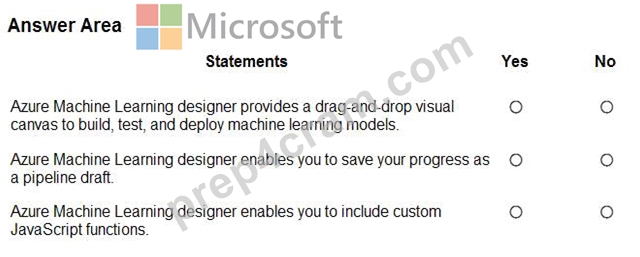
Answer:
Explanation:
Explanation:
Box 1: Yes
Azure Machine Learning designer lets you visually connect datasets and modules on an interactive canvas to create machine learning models.
Box 2: Yes
With the designer you can connect the modules to create a pipeline draft.
As you edit a pipeline in the designer, your progress is saved as a pipeline draft.
Box 3: No
Reference:
https://docs.microsoft.com/en-us/azure/machine-learning/concept-designer
NEW QUESTION # 170
Select the answer that correctly completes the sentence.
Answer:
Explanation:
NEW QUESTION # 171
Select the answer that correctly completes the sentence.
Answer:
Explanation:
Explanation
NEW QUESTION # 172
For each of the following statements, select Yes if the statement is true. Otherwise, select No.
NOTE: Each correct selection is worth one point.
Answer:
Explanation:
Reference:
https://docs.microsoft.com/en-gb/azure/cognitive-services/text-analytics/overview
https://azure.microsoft.com/en-gb/services/cognitive-services/speech-services/ You can use the Speech service to transcribe a call to text - Yes we can use Speech to Text API to achieve this
https://docs.microsoft.com/en-us/learn/modules/recognize-synthesize-speech/1-introduction You can use a speech service to translate the audio of a call to a different language - Yes we can use Speech translation service to achieve this The Speech service includes the following application programming interfaces (APIs):
Speech-to-text - used to transcribe speech from an audio source to text format.
Text-to-speech - used to generate spoken audio from a text source.
Speech Translation - used to translate speech in one language to text or speech in another.
https://docs.microsoft.com/en-us/learn/modules/translate-text-with-translation-service/2-get-started-azure You can use text analytics service to extract key entities from a call transcript -Yes Text Analytics API helps to achieve this
https://docs.microsoft.com/en-us/learn/modules/analyze-text-with-text-analytics-service/2-get-started-azure
NEW QUESTION # 173
You use Azure Machine Learning designer to publish an inference pipeline.
Which two parameters should you use to consume the pipeline? Each correct answer presents part of the solution.
NOTE: Each correct selection is worth one point.
- A. the model name
- B. the authentication key
- C. the training endpoint
- D. the REST endpoint
Answer: B,D
Explanation:
https://docs.microsoft.com/en-in/learn/modules/create-regression-model-azure-machine-learning-designer/deploy
NEW QUESTION # 174
For each of the following statements, select Yes if the statement is true. Otherwise, select No.
NOTE: Each correct selection is worth one point.
Answer:
Explanation:
NEW QUESTION # 175
To complete the sentence, select the appropriate option in the answer area.
Answer:
Explanation:
Explanation:
In the context of Microsoft Azure AI Fundamentals (AI-900) and general machine learning principles, regression refers to a type of supervised learning used to predict continuous numerical values based on historical data. The goal of regression is to model the relationship between input variables (features) and a continuous output variable (target).
In this scenario, the task is to predict how many vehicles will travel across a bridge on a given day. The number of vehicles is a numerical value that can vary continuously depending on factors such as time of day, weather, weekday/weekend, or traffic trends. Because the output is numeric and not categorical, this problem type clearly fits into regression analysis.
Microsoft's official learning content for AI-900, under "Identify features of regression and classification machine learning models," specifies that regression models are used to predict values such as sales forecasts, demand estimation, temperature prediction, or traffic volume-all of which share the same underlying objective: predicting a quantity.
To clarify other options:
* Classification is used when predicting categories or discrete classes, such as determining whether an email is spam or not spam, or if an image contains a cat or a dog.
* Clustering is an unsupervised learning technique used to group similar data points without predefined labels (for example, grouping customers by purchasing behavior).
Since predicting the number of vehicles results in a continuous numerical output, it aligns precisely with the regression workload type described in the Microsoft AI-900 study materials.
NEW QUESTION # 176
For each of the following statements, select Yes if the statement is true. Otherwise, select No.
NOTE: Each correct selection is worth one point.
Answer:
Explanation:
NEW QUESTION # 177
Match the types of natural languages processing workloads to the appropriate scenarios.
To answer, drag the appropriate workload type from the column on the left to its scenario on the right. Each workload type may be used once, more than once, or not at all.
NOTE: Each correct selection is worth one point.
Answer:
Explanation:
Reference:
https://azure.microsoft.com/en-us/services/cognitive-services/text-analytics
NEW QUESTION # 178
What ate two common use cases for generative Al solutions? Each correct answer presents a complete solution.
NOTE: Each correct selection is worth one point.
- A. predicting sales revenue based on historical data
- B. classifying email messages as spam or non-spam
- C. creating original artwork from textual descriptions
- D. generating draft responses for customer service agents
Answer: C,D
NEW QUESTION # 179
For each of the following statements, select Yes if the statement is true. Otherwise, select No.
NOTE: Each correct selection is worth one point.
Answer:
Explanation:
Explanation:
Reference:
https://docs.microsoft.com/en-gb/azure/cognitive-services/qnamaker/concepts/data-sources-and-content
https://docs.microsoft.com/en-us/azure/cognitive-services/luis/choose-natural-language-processing-service QnA maker conversational AI service and has nothing to do with SQL database You can easily create a user support bot solution on Microsoft Azure using a combination of two core technologies:
- QnA Maker. This cognitive service enables you to create and publish a knowledge base with built-in natural language processing capabilities.
- Azure Bot Service. This service provides a framework for developing, publishing, and managing bots on Azure.
https://docs.microsoft.com/en-us/learn/modules/build-faq-chatbot-qna-maker-azure-bot-service/2-get-started- qna-bot LUIS is used to understand user intent from utterances.
Creating a language understanding application with Language Understanding consists of two main tasks. First you must define entities, intents, and utterances with which to train the language model - referred to as authoring the model. Then you must publish the model so that client applications can use it for intent and entity prediction based on user input.
https://docs.microsoft.com/en-us/azure/cognitive-services/luis/choose-natural-language-processing-service
NEW QUESTION # 180
......
New (2026) Microsoft AI-900 Exam Dumps: https://pass4sure.prep4cram.com/AI-900-exam-cram.html
