

[2026] Pass your AZ-204 exam with this 100% Free AZ-204 Braindump
View All AZ-204 Actual Exam Questions, Answers and Explanations for Free
NEW QUESTION # 23
Case Study 2
Requirements
ContentAnalysisService
The company's data science group built ContentAnalysisService which accepts user generated content as a string and returns a probable value for inappropriate content. Any values over a specific threshold must be reviewed by an employee of Contoso, Ltd.
You must create an Azure Function named CheckUserContent to perform the content checks.
Costs
You must minimize costs for all Azure services.
Manual review
To review content, the user must authenticate to the website portion of the ContentAnalysisService using their Azure AD credentials. The website is built using React and all pages and API endpoints require authentication. In order to review content a user must be part of a ContentReviewer role. All completed reviews must include the reviewer's email address for auditing purposes.
High availability
All services must run in multiple regions. The failure of any service in a region must not impact overall application availability.
Monitoring
An alert must be raised if the ContentUploadService uses more than 80 percent of available CPU-cores.
Security
You have the following security requirements:
* Any web service accessible over the Internet must be protected from cross site scripting attacks.
* All websites and services must use SSL from a valid root certificate authority.
* Azure Storage access keys must only be stored in memory and must be available only to the service.
* All Internal services must only be accessible from Internal Virtual Networks (VNets)
* All parts of the system must support inbound and outbound traffic restrictions.
* All service calls must be authenticated by using Azure AD.
User agreements
When a user submits content, they must agree to a user agreement. The agreement allows employees of Contoso.Ltd to review content, store cookies on user devices and track user's IP addresses.
Information regarding agreements is used by multiple divisions within Contoso, Ltd.
User responses must not be lost and must be available to all parties regardless of individual service uptime. The volume of agreements is expected to be in the millions per hour.
Validation testing
When a new version of the ContentAnalysisService is available the previous seven days of content must be processed with the new version to verify that the new version does not significantly deviate from the old version.
Issues
Users of the ContentUploadService report that they occasionally see HTTP 502 responses on specific pages.
Code
ContentUploadService
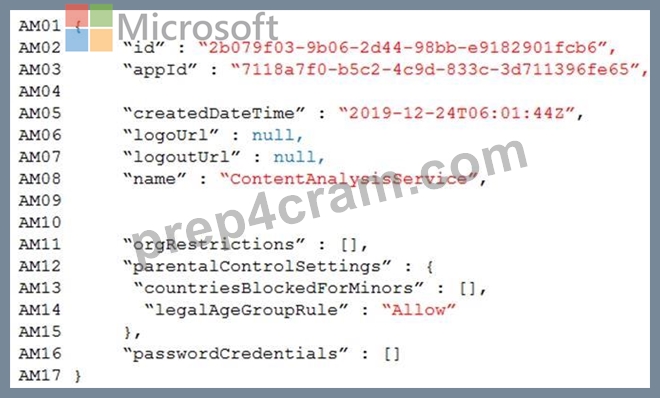
You need to configure the ContentUploadService deployment.
Which two actions should you perform? Each correct answer presents part of the solution.
NOTE: Each correct selection is worth one point.
- A. Add the following markup to line CS24:
osType: Windows - B. Add the following markup to line CS23:
types: Public - C. Add the following markup to line CS23:
types: Private - D. Add the following markup to line CS24:
osType: Linux
Answer: C
Explanation:
Scenario: All Internal services must only be accessible from Internal Virtual Networks (VNets) There are three Network Location types - Private, Public and Domain Reference:
https://devblogs.microsoft.com/powershell/setting-network-location-to-private/
NEW QUESTION # 24
You are building a traffic monitoring system that monitors traffic along six highways. The system produces time series analysis-based reports for each highway. Data from traffic sensors are stored in Azure Event Hub.
Traffic data is consumed by four departments. Each department has an Azure Web App that displays the time-series-based reports and contains a WebJob that processes the incoming data from Event Hub. All Web Apps run on App Service Plans with three instances.
Data throughout must be maximized. Latency must be minimized.
You need to implement the Azure Event Hub.
Which settings should you use? To answer, select the appropriate options in the answer area.
NOTE: Each correct selection is worth one point.
Answer:
Explanation:
Explanation
Box 1: 6
The number of partitions is specified at creation and must be between 2 and 32.
There are 6 highways.
Box 2: Highway
References:
https://docs.microsoft.com/en-us/azure/event-hubs/event-hubs-features
NEW QUESTION # 25
You are developing an application to store and retrieve data in Azure Blob storage. The application will be hosted in an on-premises virtual machine (VM). The VM is connected to Azure by using a Site-to-Site VPN gateway connection. The application is secured by using Azure Active Directory (Azure AD) credentials.
The application must be granted access to the Azure Blob storage account with a start time, expiry time, and read permissions. The Azure Blob storage account access must use the Azure AD credentials of the application to secure data access. Data access must be able to be revoked if the client application security is breached.
You need to secure the application access to Azure Blob storage.
Which security features should you use? To answer select the appropriate options in the answer area.
NOTE: Each correct selection is worth one point.
Answer:
Explanation:
Explanation: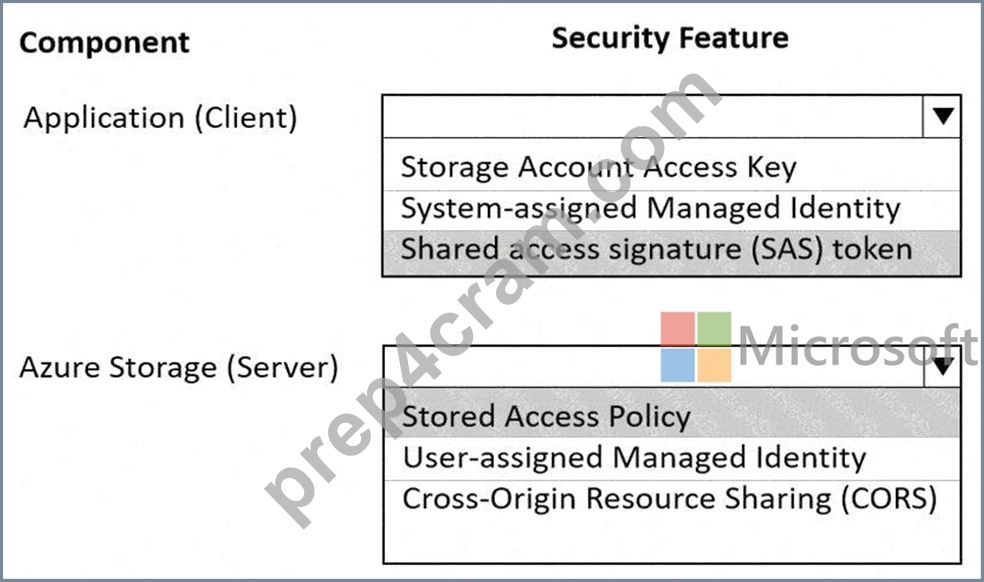
Box 1: Shared access signature (SAS) token
When your application design requires shared access signatures for access to Blob storage, use Azure AD credentials to create a user delegation SAS when possible for superior security.
Box 2: Stored access policy
Stored access policies give you the option to revoke permissions for a service SAS without having to regenerate the storage account keys.
A shared access signature can take one of the following two forms:
Service SAS with stored access policy. A stored access policy is defined on a resource container, which can be a blob container, table, queue, or file share. The stored access policy can be used to manage constraints for one or more service shared access signatures. When you associate a service SAS with a stored access policy, the SAS inherits the constraints - the start time, expiry time, and permissions - defined for the stored access policy.
Ad hoc SAS.
Reference:
https://docs.microsoft.com/en-us/azure/storage/common/storage-sas-overview
NEW QUESTION # 26
You are implementing an order processing system. A point of sale application publishes orders to topics in an Azure Service Bus queue. The label property for the topic includes the following data:
The system has the following requirements for subscriptions
You need to implement filtering and maximize throughput while evaluating filters.
Which filter types should you implement? To answer, drag the appropriate filter types to the correct subscriptions. Each filter type may be used once, more than once, or not at all. You may need to drag the split bar between panes or scroll to view content.
NOTE: Each correct selection is worth one point.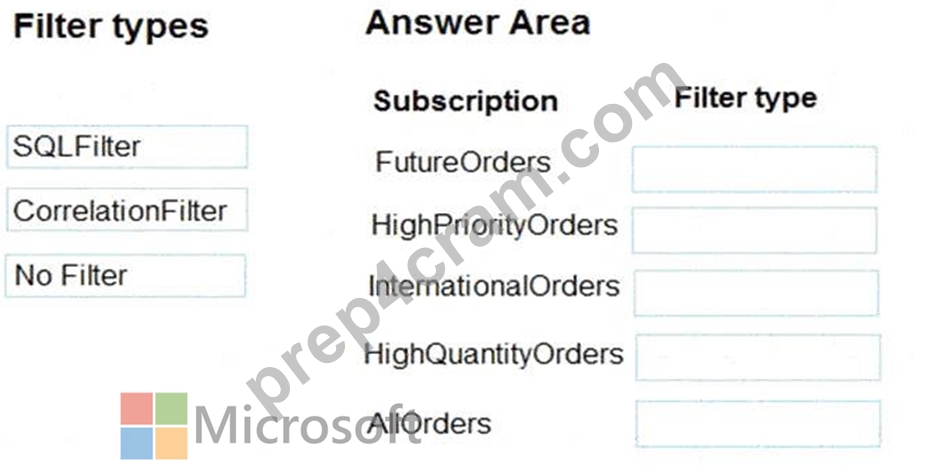
Answer:
Explanation:
Explanation:
FutureOrders: SQLFilter
HighPriortyOrders: CorrelationFilter
CorrelationID only
InternationalOrders: SQLFilter
Country NOT USA requires an SQL Filter
HighQuantityOrders: SQLFilter
Need to use relational operators so an SQL Filter is needed.
AllOrders: No Filter
SQL Filter: SQL Filters - A SqlFilter holds a SQL-like conditional expression that is evaluated in the broker against the arriving messages' user-defined properties and system properties. All system properties must be prefixed with sys. in the conditional expression. The SQL-language subset for filter conditions tests for the existence of properties (EXISTS), as well as for null-values (IS NULL), logical NOT/AND/OR, relational operators, simple numeric arithmetic, and simple text pattern matching with LIKE.
Correlation Filters - A CorrelationFilter holds a set of conditions that are matched against one or more of an arriving message's user and system properties. A common use is to match against the CorrelationId property, but the application can also choose to match against ContentType, Label, MessageId, ReplyTo, ReplyToSessionId, SessionId, To, and any user-defined properties. A match exists when an arriving message's value for a property is equal to the value specified in the correlation filter. For string expressions, the comparison is case-sensitive. When specifying multiple match properties, the filter combines them as a logical AND condition, meaning for the filter to match, all conditions must match.
Boolean filters - The TrueFilter and FalseFilter either cause all arriving messages (true) or none of the arriving messages (false) to be selected for the subscription.
References:
https://docs.microsoft.com/en-us/azure/service-bus-messaging/topic-filters
NEW QUESTION # 27
You are working for Contoso, Ltd.
You define an API Policy object by using the following XML markup:
For each of the following statements, select Yes if the statement is true. Otherwise, select No.
NOTE: Each correct selection is worth one point.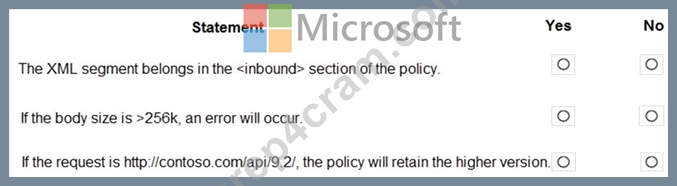
Answer:
Explanation:
Reference:
https://docs.microsoft.com/en-us/azure/api-management/api-management-transformation-policies
NEW QUESTION # 28
You need to update the APIs to resolve the testing error.
How should you complete the Azure CLI command? To answer, select the appropriate options in the answer area.
NOTE: Each correct selection is worth one point.
Answer:
Explanation:
Reference:
http://donovanbrown.com/post/How-to-clear-No-Access-Control-Allow-Origin-header-error-with-Azure-App-Service
NEW QUESTION # 29
A company is developing a Java web app. The web app code is hosted in a GitHub repository located at https://github.com/Contoso/webapp.
The web app must be evaluated before it is moved to production. You must deploy the initial code release to a deployment slot named staging.
You need to create the web app and deploy the code.
How should you complete the commands? To answer, select the appropriate options in the answer area.
NOTE: Each correct selection is worth one point.
Answer:
Explanation: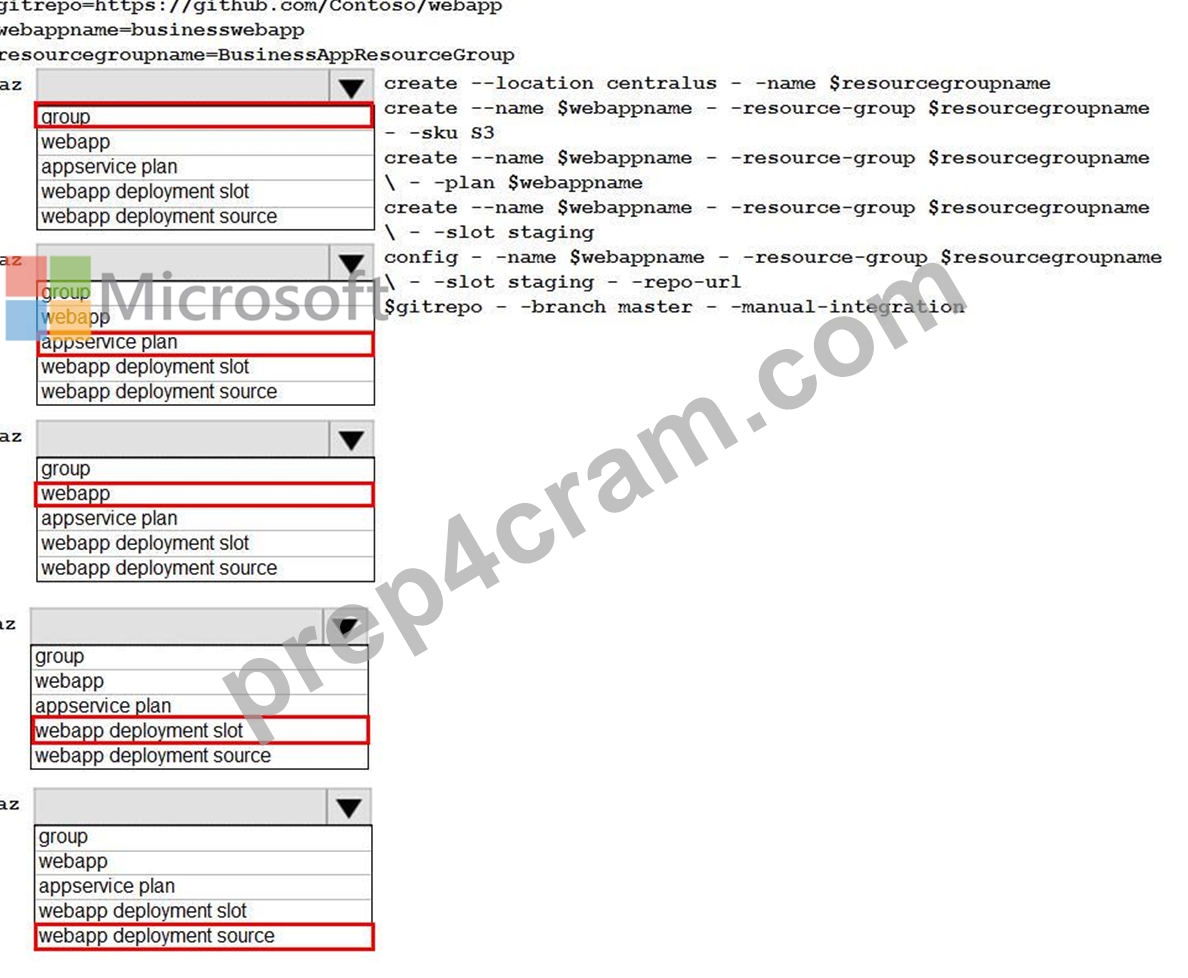
References:
https://docs.microsoft.com/en-us/azure/app-service/scripts/cli-deploy-staging-environment
NEW QUESTION # 30
You are developing a solution that will use Azure messaging services.
You need to ensure that the solution uses a publish-subscribe model and eliminates the need for constant polling.
What are two possible ways to achieve the goal? Each correct answer presents a complete solution.
NOTE: Each correct selection is worth one point.
- A. Service Bus
- B. Event Grid
- C. Event Hub
- D. Queue
Answer: A,B
Explanation:
Explanation
It is strongly recommended to use available messaging products and services that support a publish-subscribe model, rather than building your own. In Azure, consider using Service Bus or Event Grid. Other technologies that can be used for pub/sub messaging include Redis, RabbitMQ, and Apache Kafka.
Reference:
https://docs.microsoft.com/en-us/azure/architecture/patterns/publisher-subscriber
NEW QUESTION # 31
You are developing an ASP.NET Core website that can be used to manage photographs which are stored in Azure Blob Storage containers.
Users of the website authenticate by using their Azure Active Directory (Azure AD) credentials.
You implement role-based access control (RBAC) role permission on the containers that store photographs.
You assign users to RBAC role.
You need to configure the website's Azure AD Application so that user's permissions can be used with the Azure Blob containers.
How should you configure the application? To answer, drag the appropriate setting to the correct location.
Each setting may be used once, more than once, or not at all. You may need to drag the split bar between panes or scroll to view content.
NOTE: Each correct selection is worth one point.
Answer:
Explanation:
Explanation:
Box 1: user_impersonation
Box 2: delegated
Example:
1.Select the API permissions section
2.Click the Add a permission button and then:
Ensure that the My APIs tab is selected
3.In the list of APIs, select the API TodoListService-aspnetcore.
4.In the Delegated permissions section, ensure that the right permissions are checked: user_impersonation.
5.Select the Add permissions button.
Box 3: delegated
Example
1.Select the API permissions section
2.Click the Add a permission button and then,
Ensure that the Microsoft APIs tab is selected
3.In the Commonly used Microsoft APIs section, click on Microsoft Graph
4.In the Delegated permissions section, ensure that the right permissions are checked: User.Read. Use the search box if necessary.
5.Select the Add permissions button
References:
https://docs.microsoft.com/en-us/samples/azure-samples/active-directory-dotnet-webapp-webapi- openidconnect-aspnetcore/calling-a-web-api-in-an-aspnet-core-web-application-using-azure-ad/
NEW QUESTION # 32
A web service provides customer summary information for e-commerce partners. The web service is implemented as an Azure Function app with an HTTP trigger. Access to the API is provided by an Azure API Management instance. The API Management instance is configured in consumption plan mode. All API calls are authenticated by using OAuth.
API calls must be cached. Customers must not be able to view cached data for other customers.
You need to configure API Management policies for caching.
How should you complete the policy statement?
Answer:
Explanation:
Explanation
Box 1: internal
caching-type
Choose between the following values of the attribute:
internal to use the built-in API Management cache,
external to use the external cache as Azure Cache for Redis
prefer-external to use external cache if configured or internal cache otherwise.
Box 2: private
downstream-caching-type
This attribute must be set to one of the following values.
none - downstream caching is not allowed.
private - downstream private caching is allowed.
public - private and shared downstream caching is allowed.
Box 3: Authorization
<vary-by-header>Authorization</vary-by-header>
<!-- should be present when allow-private-response-caching is "true"--> Note: Start caching responses per value of specified header, such as Accept, Accept-Charset, Accept-Encoding, Accept-Language, Authorization, Expect, From, Host, If-Match Reference:
https://docs.microsoft.com/en-us/azure/api-management/api-management-caching-policies
NEW QUESTION # 33
You develop Azure solutions.
You must connect to a No-SQL globally-distributed database by using the .NET API.
You need to create an object to configure and execute requests in the database.
Which code segment should you use?
- A. new Database(Endpoint, PrimaryKey);
- B. new CosmosClient(EndpointUri, PrimaryKey);
- C. new Container(EndpointUri, PrimaryKey);
Answer: B
Explanation:
Example:
// Create a new instance of the Cosmos Client
this.cosmosClient = new CosmosClient(EndpointUri, PrimaryKey)
//ADD THIS PART TO YOUR CODE
await this.CreateDatabaseAsync();
Reference:
https://docs.microsoft.com/en-us/azure/cosmos-db/sql-api-get-started
NEW QUESTION # 34
You are developing an application that uses a premium block blob storage account. You are optimizing costs by automating Azure Blob Storage access tiers.
You apply the following policy rules to the storage account. You must determine the implications of applying the rules to the dat a. (Line numbers are included for reference only.)

Answer:
Explanation:
NEW QUESTION # 35
A software as a service (SaaS) company provides document management services. The company has a service that consists of several Azure web apps. All Azure web apps run in an Azure App Service Plan named PrimaryASP.
You are developing a new web service by using a web app named ExcelParser. The web app contains a third-party library for processing Microsoft Excel files. The license for the third-party library stipulates that you can only run a single instance of the library.
You need to configure the service.
How should you complete the script? To answer, select the appropriate options in the answer area.
NOTE: Each correct selection is worth one point.
Answer:
Explanation:
Reference:
https://docs.microsoft.com/en-us/azure/app-service/manage-scale-per-app
NEW QUESTION # 36
You are developing an application. You have an Azure user account that has access to two subscriptions.
You need to retrieve a storage account key secret from Azure Key Vault.
In which order should you arrange the PowerShell commands to develop the solution? To answer, move all commands from the list of commands to the answer area and arrange them in the correct order.
Answer:
Explanation:
Explanation
Step 1: Get-AzSubscription
If you have multiple subscriptions, you might have to specify the one that was used to create your key vault.
Enter the following to see the subscriptions for your account:
Get-AzSubscription
Step 2: Set-AzContext -SubscriptionId
To specify the subscription that's associated with the key vault you'll be logging, enter:
Set-AzContext -SubscriptionId <subscriptionID>
Step 3: Get-AzStorageAccountKey
You must get that storage account key.
Step 4: $secretvalue = ConvertTo-SecureString <storageAccountKey> -AsPlainText -Force Set-AzKeyVaultSecret -VaultName <vaultName> -Name <secretName> -SecretValue $secretvalue After retrieving your secret (in this case, your storage account key), you must convert that key to a secure string, and then create a secret with that value in your key vault.
Step 5: Get-AzKeyVaultSecret
Next, get the URI for the secret you created. You'll need this URI in a later step to call the key vault and retrieve your secret. Run the following PowerShell command and make note of the ID value, which is the secret's URI:
Get-AzKeyVaultSecret -VaultName <vaultName>
Reference:
https://docs.microsoft.com/bs-latn-ba/Azure/key-vault/key-vault-key-rotation-log-monitoring
NEW QUESTION # 37
You are developing a solution for a hospital to support the following use cases:
*The most recent patient status details must be retrieved even if multiple users in different locations have updated the patient record.
*Patient health monitoring data retrieved must be the current version or the prior version.
*After a patient is discharged and all charges have been assessed, the patient billing record contains the final charges.
You provision a Cosmos DB NoSQL database and set the default consistency level for the database account to Strong. You set the value for Indexing Mode to Consistent.
You need to minimize latency and any impact to the availability of the solution. You must override the default consistency level at the query level to meet the required consistency guarantees for the scenarios.
Which consistency levels should you implement? To answer, drag the appropriate consistency levels to the correct requirements. Each consistency level may be used once, more than once, or not at all. You may need to drag the split bar between panes or scroll to view content.
NOTE: Each correct selection is worth one point.
Answer:
Explanation:
Explanation
Box 1: Strong
Strong: Strong consistency offers a linearizability guarantee. The reads are guaranteed to return the most recent committed version of an item. A client never sees an uncommitted or partial write. Users are always guaranteed to read the latest committed write.
Box 2: Bounded staleness
Bounded staleness: The reads are guaranteed to honor the consistent-prefix guarantee. The reads might lag behind writes by at most "K" versions (that is "updates") of an item or by "t" time interval. When you choose bounded staleness, the "staleness" can be configured in two ways:
The number of versions (K) of the item
The time interval (t) by which the reads might lag behind the writes
Box 3: Eventual
Eventual: There's no ordering guarantee for reads. In the absence of any further writes, the replicas eventually converge.
NEW QUESTION # 38
......
What is the duration, language, and format of AZ-204: Developing Solutions for Microsoft Azure Exam
- Language: English
- Passing Score: 700 / 1000
- Number of Questions: 40 to 60 questions(Since Microsoft does not publish this information, the number of exam questions may change without notice.)
- This is beta exam.
AZ-204 dumps Free Test Engine Verified By It Certified Experts: https://pass4sure.prep4cram.com/AZ-204-exam-cram.html
