

[May 18, 2026] Latest Questions 2V0-11.25 Guide to Prepare Free Practice Tests
Reliable 2V0-11.25 Dumps Questions Available as Web-Based Practice Test Engine
NEW QUESTION # 95
Which feature of VMware Lifecycle Manager allows an administrator to manage the lifecycle of ESXi hosts by applying a consistent image across the hosts in a cluster?
- A. Update Manager Baselines
- B. Lifecycle Manager Images
- C. Host Profiles
- D. vSphere Auto Deploy
Answer: B
Explanation:
VMware Lifecycle Manager (vLCM) enables administrators to manage the lifecycle of ESXi hosts by applying a consistent image across the hosts in a cluster. These images include the ESXi version, firmware, drivers, and settings, ensuring consistency and simplifying updates and patches across all hosts in a cluster.
NEW QUESTION # 96
An administrator needs to delete and re-deploy an NSX Edge cluster that was originally deployed from SDDC Manager and has downloaded the edge cleaner tool.
Where should the administrator run the tool to complete this task?
- A. On the NSX Manager VM.
- B. On the Cloud Builder VM.
- C. On the Edge cluster node VM(s).
- D. On the SDDC Manager VM.
Answer: C
Explanation:
The NSX Edge Cleaner tool is typically run on the Edge cluster node VM(s) to clean up the previous configuration and ensure that the node(s) are properly removed before re-deploying the NSX Edge cluster. This process helps to reset the environment and remove any leftover configurations that may affect the re-deployment.
NEW QUESTION # 97
An organization has 3 data center sites and is implementing a solution to achieve a Recovery Point Objective (RPO) of 0 to ensure continuous availability of storage in the event of a single site failure. The sites are connected via a high bandwidth/low latency link.
Which two VMware Cloud Foundation (VCF) components can be used to support this capability? (Choose two.)
- A. vSAN
- B. Aria Operations
- C. vSphere Replication
- D. NSX
- E. vSphere
Answer: A,E
Explanation:
Comprehensive and Detailed Explanation From Exact Extract:
To achieve an RPO of 0 (zero data loss) with continuous availability of storage across multiple sites, VMware Cloud Foundation leverages two key components:
vSphere (A): vSphere provides the core platform for compute virtualization, including features such as VMware vSphere HA (High Availability) and VMware vSphere Fault Tolerance, both of which are integral to delivering continuous VM availability and supporting cross-site failover.
vSAN (E): vSAN can be configured in a stretched cluster deployment across the three sites. With a stretched vSAN cluster, data is synchronously replicated between sites, ensuring that all writes are committed to more than one location. This synchronous replication provides true continuous availability and a Recovery Point Objective (RPO) of 0 in the event of a single site failure, provided that the network meets high bandwidth and low latency requirements.
Other components such as Aria Operations and NSX do not provide storage-level availability or synchronous data protection. vSphere Replication only supports asynchronous replication and cannot guarantee RPO of 0.
NEW QUESTION # 98
An administrator needs to configure an ESXi host and create a host profile to ensure consistent configuration across multiple hosts in a cluster.
Which three steps are necessary to achieve this? (Choose three.)
- A. Remediate the non-compliant hosts to ensure they match the host profile.
- B. Manually configure each host to match the reference host settings.
- C. Extract the host profile from the configured reference host.
- D. Apply the host profile to all hosts in the cluster.
- E. Configure the desired settings on a reference ESXi host.
Answer: A,C,E
Explanation:
First, configure the desired settings on a reference ESXi host. This host will be used as the template for creating a consistent configuration across the cluster.
After configuring the reference host, extract the host profile from it. This captures the configuration of the reference host as a host profile.
Remediation is necessary to ensure that other hosts in the cluster align with the reference host's configuration. The host profile can be applied, and remediation will correct any non-compliant settings on other hosts.
NEW QUESTION # 99
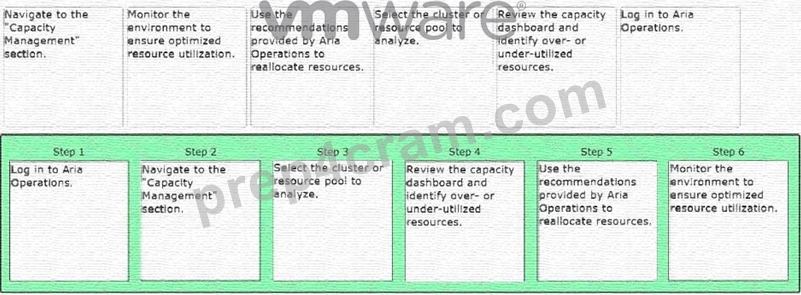
DRAG DROP
Put the following steps in the correct order to optimize resource allocation using Aria Operations.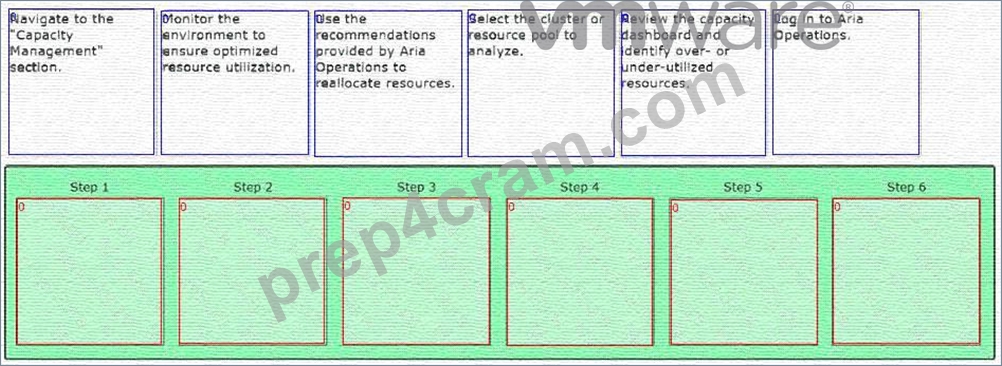
Answer:
Explanation: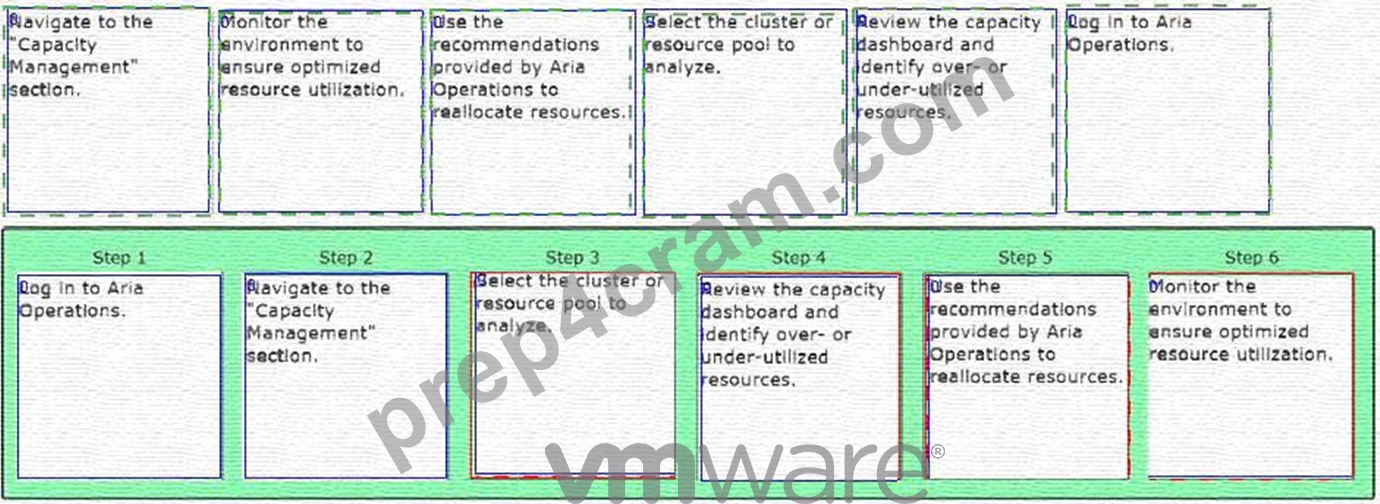
NEW QUESTION # 100
A newly added ESXi host is not able to communicate with the vCenter Server.
What three steps should an administrator take to diagnose and resolve this issue? (Choose three.)
- A. Verify the network configuration on the ESXi host
- B. Use the vSphere Client to review the host's network settings
- C. Restart the manaqement aqents on the ESXi host
- D. Check the license on the ESXi host
- E. Ensure that the management network is correctly configured and reachable
Answer: A,C,E
Explanation:
Verifying the network configuration on the ESXi host ensures that the host is correctly configured for network communication with the vCenter Server.
The management network must be properly configured and reachable from the ESXi host to communicate with the vCenter Server.
Restarting the management agents on the ESXi host can resolve issues related to communication between the ESXi host and vCenter Server, as sometimes the agents might become unresponsive.
NEW QUESTION # 101
An administrator is deploying a new VMware Cloud Foundation (VCF) environment. After uploading the completed Deployment Parameter Workbook, the validation task fails and an error message is displayed within the VMware Cloud Builder GUI.
Which log file can the administrator use to identify the cause of the validation error?
- A. domainmanager.log
- B. vcf-bringup-debug.log
- C. sos.log
- D. jsongenerator-<timestamp>.log
Answer: B
Explanation:
According to the official VMware Cloud Foundation Deployment Guide and VMware Cloud Builder troubleshooting documentation, theprimary log fileused for tracking and diagnosing bring-up and validation errors in a new VCF deployment is:
A). vcf-bringup-debug.log
Exact Extract from VMware Documentation:
"The vcf-bringup-debug.log file records detailed information about all bring-up operations, including parameter validation checks, environment checks, and errors encountered during the deployment process.
When a validation task fails in the Cloud Builder GUI, this log file provides the necessary diagnostic information to identify the cause of the error." Why Not the Other Options?
B). sos.log:Used for SDDC Manager service health and not specific to Cloud Builder validation or deployment tasks.
C). domainmanager.log:Used for ongoing domain management and operations within SDDC Manager, not for Cloud Builder or bring-up process.
D). jsongenerator-<timestamp>.log:Related to the generation of JSON files from the parameter workbook, but not the source for in-depth validation or deployment errors.
Summary:
When a validation task fails during the deployment of a new VMware Cloud Foundation environment in Cloud Builder, the administrator should review thevcf-bringup-debug.logfile to diagnose and resolve the error, as directed by official VMware documentation.
NEW QUESTION # 102
The administrator of a VMware Cloud Foundation environment notices that log data from multiple components, including vSphere, NSX, and vSAN, is not being collected in Aria Operations for Logs.
What two steps should the administrator perform to resolve this issue? (Choose two.)
- A. Ensure that the syslog configuration on each component is pointing to the correct Aria Operations for Logs server.
- B. Increase the storage capacity of the Aria Operations for Logs server to accommodate more log data.
- C. Reconfigure the log level settings on all vSphere components to ensure detailed logging.
- D. Verify that the Aria Operations for Logs license is still valid and active.
- E. Check the network connectivity between the Aria Operations for Logs server and the VMware Cloud Foundation components.
Answer: A,E
Explanation:
If Aria Operations for Logs cannot reach the vSphere, NSX, or vSAN components over the network, no logs will be collected-so validating connectivity (firewalls, routing, DNS) is essential.
Each component's syslog settings must point to the correct Aria Operations for Logs endpoint; if they're misconfigured, logs won't be forwarded.
NEW QUESTION # 103
An administrator logged into NSX Manager to view host details. The administrator noticed that the "Tunnel" status for the ESXi hosts, in the VI workload domain, is showing down.
What is a possible reason the ESXi host tunnels are showing down in NSX?
- A. The host TEP IP addresses are being dynamically assigned through DHCP instead of being statically assigned.
- B. The MTU setting for the host TEPs has been set to 1500.
- C. The IGMP has been disabled on the network.
- D. The overlay traffic is being blocked by the gateway firewall.
Answer: B
Explanation:
The "Tunnel" status in NSX indicates the status of the VXLAN tunnels used for communication between ESXi hosts. If the MTU setting for the host Tunnel Endpoint (TEP) is incorrectly set to 1500, this can cause issues with VXLAN encapsulation, as VXLAN packets typically require an MTU of at least 1600 bytes to function correctly. Setting the MTU too low can cause packet drops and result in the tunnel status being down.
NEW QUESTION # 104
What are three prerequisites for deploying an NSX Edge cluster in a VMware Cloud Foundation solution?
(Choose three.)
- A. Install Aria Operations and enable Edge Cluster monitoring.
- B. Set up vSAN storage policies for the Edge VMs.
- C. Assign separate VLAN IDs and subnets for the NSX host overlay and NSX Edge overlay networks.
- D. Create DNS entries for the NSX Edge nodes.
- E. Verify that the NSX host overlay VLAN and NSX Edge overlay VLAN are routed to each other.
Answer: C,D,E
Explanation:
The NSX host overlay VLAN and NSX Edge overlay VLAN need to be routed to each other to ensure proper communication between the host and NSX Edge clusters.
DNS entries for the NSX Edge nodes are required to enable name resolution, which is important for the proper functioning of the NSX Edge cluster.
Assigning separate VLAN IDs and subnets for the NSX host overlay and NSX Edge overlay networks is necessary to maintain network isolation and optimize traffic flow between components.
NEW QUESTION # 105
A virtual private cloud administrator is regularly tasked to provision and manage new application workloads with dedicated subnets.
Which two capabilities of VMware Cloud Foundation (VCF) can be used to alleviate the workload of the administrator with minimal interaction with the networking team? (Choose two.)
- A. Use of NSX overlay networks.
- B. Deploy Aria Automation to enable self-service provisioning.
- C. Configure vSAN storage policies for each application.
- D. Use vSphere Resource Pools to allocate networking resources to different applications.
Answer: A,B
Explanation:
Deploying VMware Aria Automation enables self-service blueprints that allow the administrator or application owners to provision workloads, including dedicated networks, without direct requests to the networking team.
NSX overlay networks decouple the virtual network from the physical underlay, enabling the creation of tenant-specific subnets on demand without changes to the physical network.
NEW QUESTION # 106
While preparing to enable Application Virtual Networks (AVNs) and deploying Aria Suite components, an administrator plans to deploy an NSX Edge cluster.
What is a requirement for deploying the NSX Edge cluster?
- A. The Edge cluster must be configured for NSX Federation.
- B. The Edge cluster must be deployed in the management domain.
- C. The Edge transport nodes must be configured with an MTU of 1500.
- D. The Edge transport nodes must be deployed using the 'large' form factor.
Answer: B
Explanation:
When deploying an NSX Edge cluster in a VMware Cloud Foundation (VCF) environment, it must be deployed in the management domain. The management domain is responsible for managing and orchestrating various resources, including the NSX Edge cluster, which is crucial for network virtualization and security within the environment.
NEW QUESTION # 107
A VMware Cloud Foundation administrator notices that the SDDC Manager dashboard shows an alert indicating that one of the ESXi hosts in their workload domain is in a Not Responding state.
What is the first troubleshooting step that should be performed to resolve this issue?
- A. Remove and re-add the ESXi host to the workload domain.
- B. Upgrade the ESXi host to the latest version.
- C. Check the network connectivity between the ESXi host and the SDDC Manager.
- D. Reboot the ESXi host from the SDDC Manager interface.
Answer: C
Explanation:
When an ESXi host is in a "Not Responding" state in VMware Cloud Foundation, the first step in troubleshooting is to check the network connectivity between the ESXi host and the SDDC Manager.
Network issues (e.g., misconfigured VLANs, firewall settings, or network outages) are often the primary cause of communication problems between SDDC Manager and the ESXi host.
NEW QUESTION # 108
Which command verifies the successful installation of the Tanzu CLI tools on a developer workstation?
- A. vcli --check
- B. vicli version
- C. vsphere -v
- D. tanzu version
Answer: D
Explanation:
To verify the successful installation of the Tanzu CLI tools, you can use the tanzu version command. This command displays the version of the Tanzu CLI, confirming that the tools are properly installed on the developer workstation.
NEW QUESTION # 109
An administrator is managing a VMware Cloud Foundation (VCF) environment. To support virtual machine backup using a third-party tool, the administrator has been tasked with assigning a service account (srvbackup01) access to the Production Virtual Machine (VM) folder and all child objects. The company security policy dictates that only the minimum required permissions must be assigned to service accounts to ensure they can function as designed.
Which three actions should the administrator take in the vSphere Client to complete the objective? (Choose three.)
- A. Create a new Role called backup_service.
- B. Select the necessary privileges for the backup_service role.
- C. Assign the backup_service role to the srvbackup01 user on the Production VM folder only.
- D. Assign the Administrator role to the srvbackup01 user on the Production VM folder and propagate to all child objects.
- E. Assign the backup_service role to the srvbackup01 user on the Production VM folder and propagate to all child objects.
- F. Clone the Administrator Role to create the backup_service role.
Answer: A,B,E
Explanation:
You need a dedicated backup_service role to tailor permissions.
Populate that role with only the required privileges for backup operations.
Assign the backup_service role to srvbackup01 on the Production VM folder and enable propagation so all child VMs inherit those minimal permissions.
NEW QUESTION # 110
Which two SDDC Manager operations can be executed on an NSX Edge cluster after it has been deployed?
(Choose two.)
- A. Redeploy
- B. Expand
- C. Shrink
- D. Delete
- E. |Sync
Answer: D,E
Explanation:
After an NSX Edge cluster has been deployed, you can perform a sync operation to ensure the NSX Edge cluster is in sync with the configuration in SDDC Manager.
Deleting an NSX Edge cluster can be done after it has been deployed if it is no longer required or needs to be removed from the environment.
NEW QUESTION # 111
An administrator is tasked with deploying a new, highly-available application on a VMware Cloud Foundation (VCF)-based private cloud. The new application will include both virtual machines and containers.
Which two components of VCF could the administrator use to complete the task? (Choose two.)
- A. Supervisor
- B. NSX
- C. Aria Suite Lifecycle
- D. Aria operations
- E. HCX
Answer: A,B
Explanation:
NSX provides the networking, security, and load-balancing services needed for high availability, while vSphere Supervisor enables Kubernetes integration alongside VMs, allowing you to run and manage containerized workloads on the same platform.
NEW QUESTION # 112
An administrator has been tasked with expanding an existing VMware Cloud Foundation environment by adding a new workload domain. The environment currently has one management domain and one VI workload domain.
What options are available to the administrator for deploying NSX in the second VI workload domain?
- A. The new workload domain must have a dedicated NSX Fabric.
- B. The new workload domain can have its own dedicated NSX Fabric or it can join the existing NSX Fabric configured in the management domain.
- C. The new workload domain can have a dedicated NSX Fabric or it can join the existing NSX Fabric configured in either the management domain or existing VI domain.
- D. The new workload domain can have its own dedicated NSX Fabric or it can join the existing NSX Fabric configured in the existing VI domain.
Answer: C
Explanation:
When expanding a VMware Cloud Foundation environment with a new workload domain, you have the flexibility to either configure a dedicated NSX Fabric for the new domain or join an existing NSX Fabric from either the management domain or a previously established VI workload domain. This allows for consistent and scalable network virtualization across multiple domains in the environment.
NEW QUESTION # 113
An organization is looking to streamline its IT service delivery by automating the deployment of applications and infrastructure across its hybrid cloud environment.
Which VMware Aria Suite component should they use?
- A. Aria Operations for Networks
- B. Aria Automation
- C. Aria Operations
- D. Aria Operations for Logs
Answer: B
Explanation:
Aria Automation (formerly vRealize Automation) is designed to automate the deployment of applications and infrastructure across hybrid cloud environments. It enables the provisioning, management, and orchestration of IT services, helping organizations streamline their service delivery.
NEW QUESTION # 114
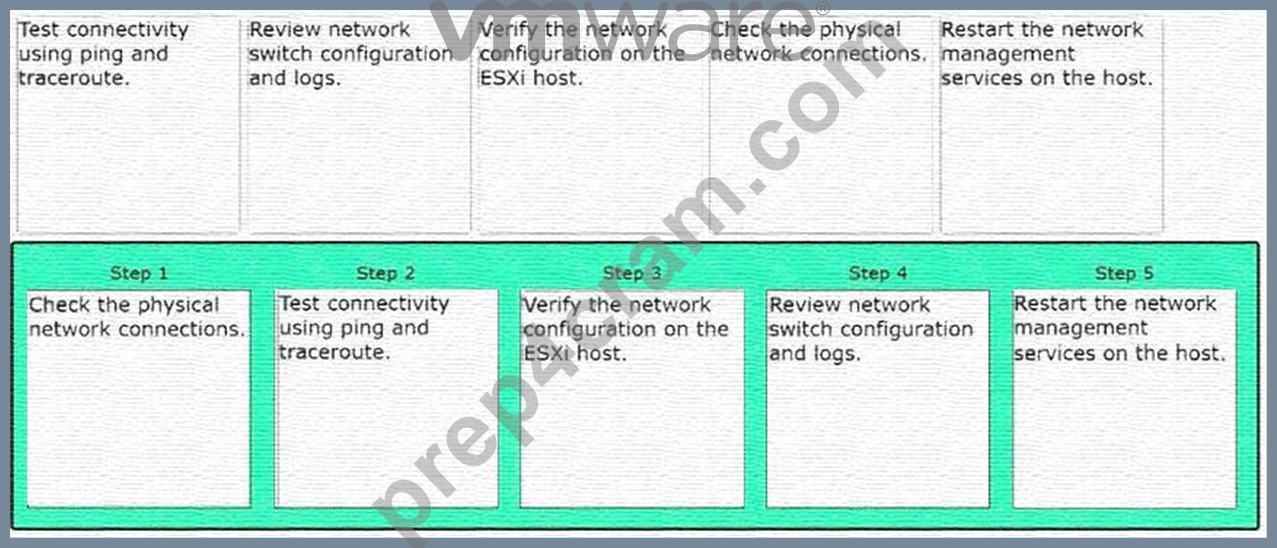
DRAG DROP
Arrange the steps in the correct order to resolve host connectivity issues.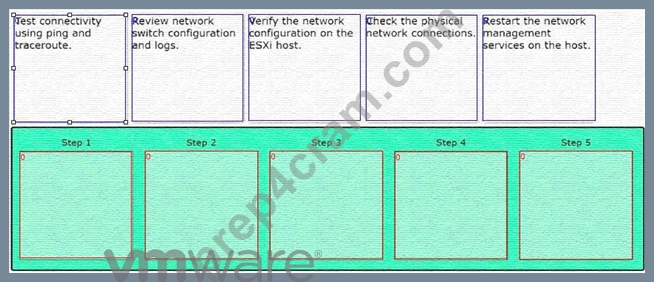
Answer:
Explanation: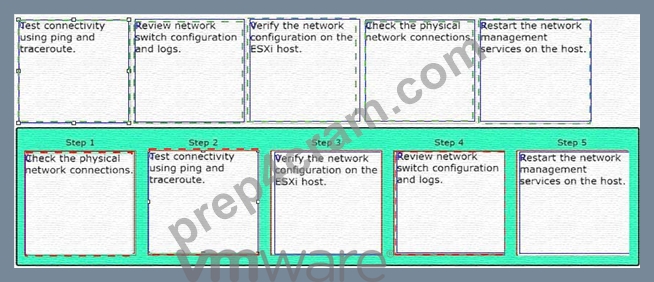
NEW QUESTION # 115
An administrator has been tasked with creating a real-time view of key performance indicators for their VMware Cloud Foundation private cloud and an automated monthly report that shows the capacity consumed by each development team who use the environment.
Which VCF component should the administrator configure to complete their objectives?
- A. VMware Aria Operations
- B. VMware Aria Operations for Logs
- C. VMware Aria Operations for Networks
- D. VMware Aria Operations for Applications
Answer: A
Explanation:
VMware Aria Operations provides comprehensive monitoring, analytics, and performance management for the entire VMware Cloud Foundation environment. It enables real-time views of key performance indicators (KPIs) and can be configured to generate automated reports on capacity consumption, which aligns with the administrator's objectives.
NEW QUESTION # 116
An organization is implementing a downtime avoidance solution and wants to ensure continuous availability of applications across separate sites that are connected via a high bandwidth/low latency link.
Which two VMware Cloud Foundation components support this capability with stretched clusters? (Choose two.)
- A. NSX Firewall
- B. vSAN
- C. vSphere Replication
- D. vVOL
- E. vSphere
Answer: B,E
Explanation:
vSAN: vSAN supports stretched clusters, allowing data to be mirrored across multiple sites to ensure continuous availability and enable high availability for virtual machines in case of a site failure.
vSphere: vSphere also supports stretched clusters, enabling the high availability of applications across multiple sites by allowing virtual machines to be run on either site in the event of a failure.
NEW QUESTION # 117
DRAG DROP
Arrange the steps in the correct order to generate a performance report in Aria Operations.
Answer:
Explanation:
A screenshot of a computer AI-generated content may be incorrect.
NEW QUESTION # 118
......
Correct and Up-to-date VMware 2V0-11.25 BrainDumps: https://pass4sure.prep4cram.com/2V0-11.25-exam-cram.html
